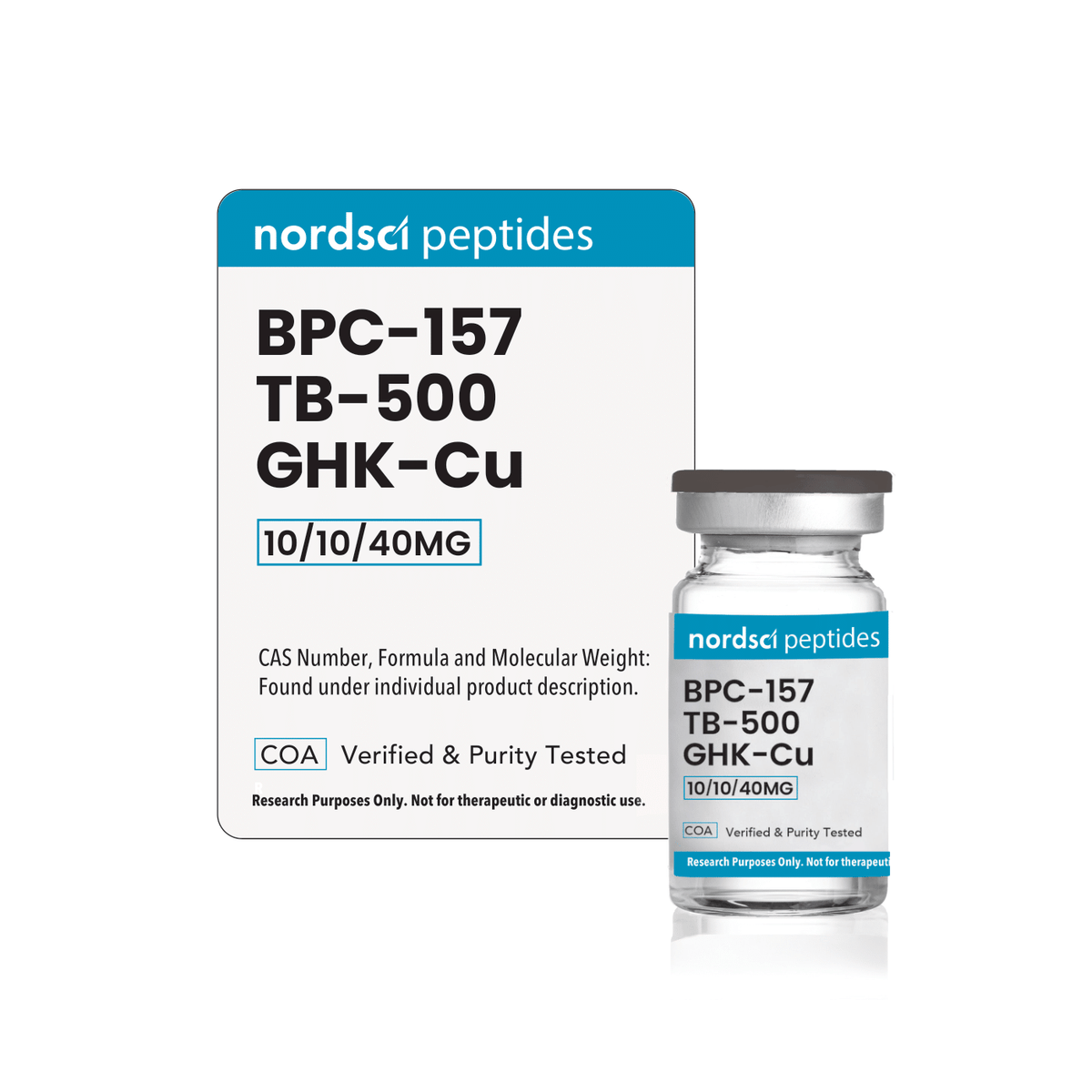
Glow Blend: BPC-157, TB-500, GHK-Cu – Product Description
Glow Blend is a research-only peptide formulation containing BPC-157, TB-500, and GHK-Cu. It is intended for in vitro laboratory analysis involving compound identity, peptide chemistry, stability, component compatibility, and controlled biochemical research.
Because Glow Blend contains multiple compounds, it does not have one molecular formula, molecular weight, CAS number, or amino-acid sequence applicable to the entire formulation. Chemical identifiers and analytical specifications are component-specific and should be verified through the product label, applicable technical documentation, and lot-specific Certificate of Analysis.
Glow Blend – Research Specifications:
| Format |
Multi-component lyophilized peptide formulation |
| Active Compounds |
BPC-157, TB-500, and GHK-Cu |
| Material Source |
Chemical synthesis |
| Appearance |
Lyophilized material |
| Molecular Formula |
No single formula applies to the complete blend; identifiers are component-specific |
| Molecular Weight |
No single molecular weight applies to the complete blend; values are component-specific |
| CAS Number |
No single CAS number applies to the complete blend |
| Sequence |
Component-specific; consult applicable technical documentation |
| Purity and Identity |
Consult the lot-specific Certificate of Analysis |
| Storage Conditions |
Store sealed in a cool, dry environment away from heat, light, and moisture. Follow the product label and laboratory SOPs. |
| Documentation |
Lot-specific analytical documentation is available through the COA Library |
| Research Classification |
Laboratory research use only. Not for human or animal consumption. |
What Is Glow Blend? Research Background and Mechanistic Context
Glow Blend combines three chemically distinct research materials within one lyophilized formulation. BPC-157 is a synthetic pentadecapeptide. TB-500 is a supplier designation associated with synthetic thymosin-beta-4-related peptide material. GHK-Cu is a copper complex of the tripeptide glycyl-L-histidyl-L-lysine.
Controlled laboratory studies may examine these compounds individually or as a combined analytical variable. Relevant areas of investigation can include compound characterization, peptide stability, molecular binding, cytoskeletal signaling, extracellular-matrix-associated pathways, and biochemical interactions under defined in vitro conditions.
Researchers requiring individual experimental variables may compare the blend with separate materials such as BPC-157, Thymosin Beta 4, or GHK-Cu. Appropriate controls are necessary when comparing a multi-component formulation with individual compounds.
Important Research Notice: Product specifications must be confirmed using the lot-specific Certificate of Analysis. Analytical documentation may include identity, purity, or other quality parameters applicable to the tested batch.
THIS PRODUCT IS INTENDED EXCLUSIVELY FOR IN VITRO LABORATORY RESEARCH. IT IS NOT FOR HUMAN OR ANIMAL CONSUMPTION AND IS NOT INTENDED FOR DIAGNOSTIC, THERAPEUTIC, VETERINARY, FOOD, DRUG, COSMETIC, OR DIETARY-SUPPLEMENT USE.
Glow Blend – Key Research Applications
1. Component Identification and Analytical Characterization
Glow Blend may be included in laboratory workflows examining the identity and analytical characteristics of a multi-component peptide formulation. Appropriate analytical techniques should be selected according to the compounds, study objectives, and institutional procedures.
2. Peptide Stability and Compatibility Studies
Controlled experiments may evaluate how the formulation behaves under defined laboratory conditions. Variables can include temperature, light exposure, storage duration, container conditions, and analytical sampling intervals. Study conclusions should remain limited to the tested material and experimental environment.
3. Multi-Input Signaling Studies (Blend vs. Single Variables)
The formulation may be compared with its individual components in controlled in vitro research. Such studies require suitable negative controls, positive controls, replicates, predefined endpoints, and analytical methods capable of distinguishing component-specific observations from combined-variable effects.
4. Biochemical Pathway and Molecular-Interaction Research
The individual compounds are discussed in scientific literature involving different biochemical pathways and molecular interactions. Glow Blend may be evaluated as a combined research variable when the study design requires simultaneous exposure to all three materials. This research classification does not establish any clinical, cosmetic, physiological, or therapeutic outcome.
Handling and Research Use Considerations
Glow Blend should be handled only by qualified laboratory personnel in appropriately equipped facilities. Laboratories should document the product lot, receipt date, storage history, study identifier, analytical method, controls, and chain of custody.
Material integrity can be affected by environmental exposure, contamination, temperature cycling, moisture, and improper handling. Researchers should follow the product label, lot-specific documentation, institutional SOPs, and applicable regulations.
Protocol Design Considerations: Multi-component materials can complicate analytical interpretation. Experimental plans should define the role of each control, the analytical endpoint, the sampling schedule, and the criteria used to attribute observations to the complete blend or an individual component.
No information on this page constitutes dosing, preparation, administration, clinical, veterinary, cosmetic, or consumer-use guidance.
Glow Blend – Certificate of Analysis (COA)
Lot-specific Certificates of Analysis are available for Glow Blend. The applicable COA should be reviewed before laboratory use to confirm the documented identity, purity, and quality parameters for the received batch.
COAs are intended for research documentation, material verification, laboratory recordkeeping, quality review, and study reproducibility. Specifications can vary by lot, so researchers should rely on the certificate associated with the exact product batch rather than a certificate from another lot.
Where to Buy Glow Blend for Research Purposes
NordSci Peptides supplies Glow Blend exclusively as a laboratory research material. Research organizations should evaluate product labeling, lot traceability, analytical documentation, storage requirements, and internal procurement policies before purchase.
IMPORTANT: Glow Blend is not a drug, food, cosmetic, dietary supplement, or medical product. It is not approved for human or veterinary use and must not be used for diagnosis, treatment, prevention, administration, consumption, or household application. Purchasers are responsible for compliance with all applicable laws, institutional policies, and laboratory requirements.
Scientific References
- Lot-specific Certificate of Analysis for Glow Blend: BPC-157, TB-500, GHK-Cu.
- Validated laboratory methods applicable to peptide identity and purity analysis.
- Chemical-characterization literature addressing BPC-157, thymosin-beta-4-related peptide materials, and GHK-Cu.
- Institutional procedures governing the receipt, storage, handling, documentation, and disposal of research-only peptide materials.