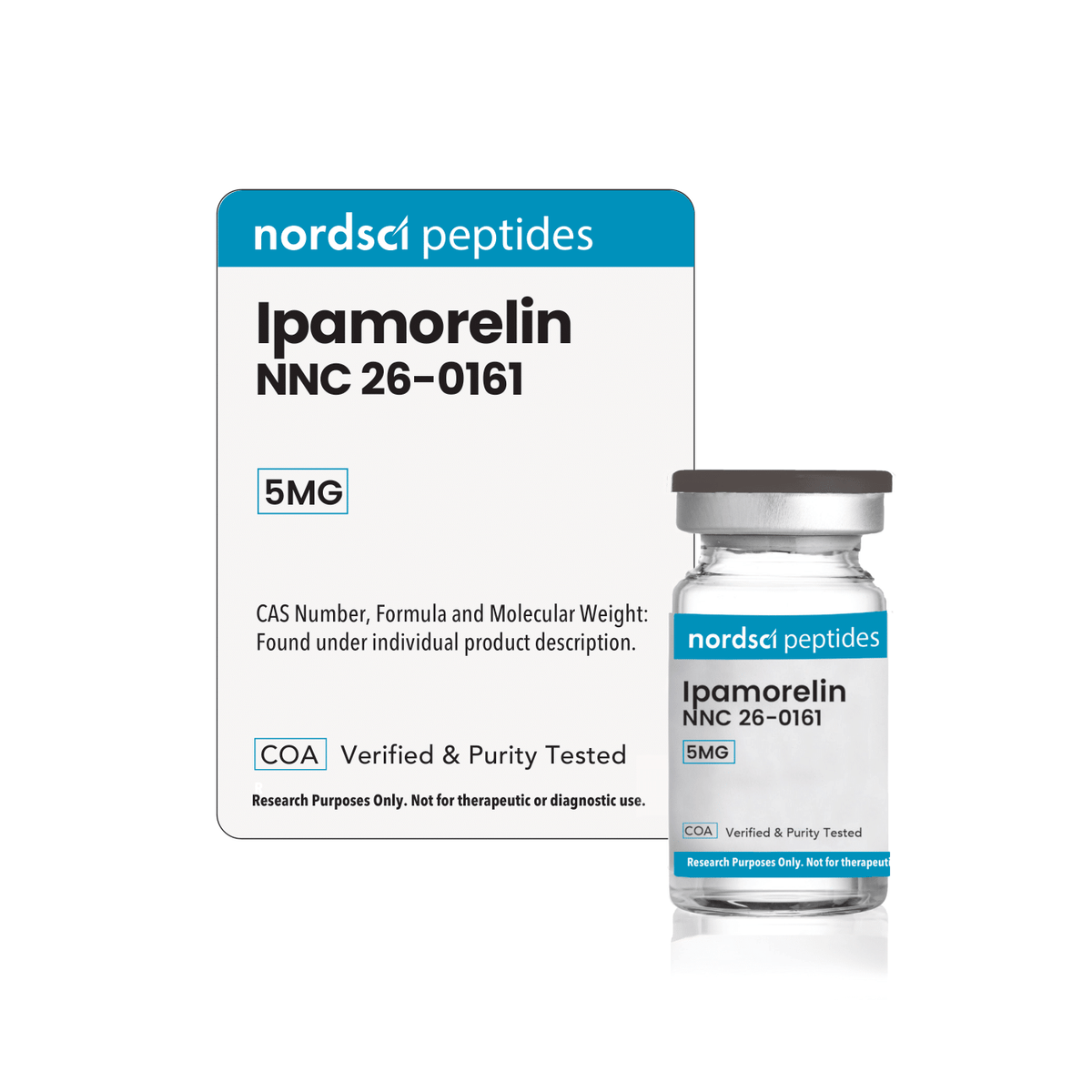
Ipamorelin (5mg)
-
Regular Price
-
$59.95
-
Sale Price
-
$59.95
-
Regular Price
-
Sold Out
-
Unit Price
- per
- Regular Price
- $59.95
- Sale Price
- $59.95
- Regular Price
- Unit Price
- per
IPAMORELIN
Specification:
| Unit Size | 5 mg/vial |
| Unit Quantity | 1 vial |
| Purity (HPLC) | 99.21% |
| Sequence |
Aib-His-D-2-Nal-D-Phe-Lys-NH2
|
| Molecular Formula | C62H98N16O22 |
| Molecular Weight | 712.03 |
| CAS | 170851-70-4 |
| Appearance | lyophilized White Powder |
| Source | Chemical Synthesis |
| Storage | Cool, dry place (away from light) |
| Terms | The products we offer are intended for laboratory research use only. Please familiarize yourself with our terms of service prior to ordering. |
Ipamorelin is a synthetic pentapeptide that has been found to have specific growth hormone (GH)-releasing properties. As a growth hormone secretagogue, it stimulates the release of growth hormone from the pituitary gland, resulting in increased muscle mass, reduced body fat, and improved bone density.
The peptide sequence of Ipamorelin is able to bind to the ghrelin/growth hormone secretagogue receptor, making it one of the most specific GH secretagogues currently known. Studies have shown that it has no effect on cortisol release, follicle-stimulating or luteinizing hormone, thyroid-stimulating hormone, or ACTH.
Ipamorelin's high level of selectivity has made it a subject of great interest in research, as it can serve as a therapeutic agent and a model peptide to uncover the mechanisms behind receptor binding selectivity.
In a study conducted on adult female rats, different doses of Ipamorelin (0, 18, 90, and 450 microg/day) were administered three times a day for 15 days to investigate its effects on longitudinal bone growth rate (LGR), body weight (BW), and GH release. The results showed that Ipamorelin dose-dependently increased LGR from 42 microm/day in the control group to 44, 50, and 52 microm/day in the treatment groups (P<0.0001). There was also a dose-dependent effect on BW gain, but no effect on total IGF-I levels, IGFBPs, or serum markers of bone formation and resorption.
The primary concern for peptide researchers today is product purity. Nord-sci guarantees our product purity by performing independent testing of our products and providing those certifications for our customers in our product descriptions.
THIS PRODUCT IS NOT INTENDED TO TREAT, CURE OR DIAGNOSE ANY CONDITION OR DISEASE AND IS NOT FOR HUMAN CONSUMPTION.
ALL PRODUCTS OFFERED ARE INTENDED FOR LABORATORY RESEARCH USE ONLY.
Mix each vial with: Bacteriostatic water. 1-2ml depending on desired dissolution.
Administration: 0.2 - 0.5 mg / 5-7 days per week
Ipamorelin (5 mg) – Product Description
Ipamorelin is a highly selective growth hormone secretagogue (GHS) peptide synthesized for controlled laboratory research. As a pentapeptide agonist of the ghrelin/growth hormone secretagogue receptor, Ipamorelin is used in preclinical models to investigate growth hormone dynamics, metabolic signaling, and tissue repair pathways under tightly regulated research conditions.
Each vial of Ipamorelin supplied by Nordsci Peptides is manufactured via controlled chemical synthesis and verified by independent third-party laboratories for identity and purity prior to release.
Ipamorelin Research Peptide Specifications:
| Unit Size | 5 mg/vial |
| Unit Quantity | 1 vial |
| Purity (HPLC) | > 99% |
| Sequence | Aib–His–D-2-Nal–D-Phe–Lys–NH2 |
| Molecular Formula | C38H49N9O5 |
| Molecular Weight | ≈ 711.9 g/mol |
| CAS Number | 170851-70-4 |
| Appearance | Lyophilized White Powder |
| Source | Chemical Synthesis |
| Storage Conditions | Store lyophilized Ipamorelin at -20 °C in a dry, dark environment. After reconstitution, store at 2–8 °C and use within the laboratory’s validated stability window. |
| Research Use Only | This peptide is supplied strictly for laboratory research use only. Not for human or veterinary use, diagnostic procedures, or therapeutic applications. |
What Is Ipamorelin? Research Background and Mechanism
Ipamorelin is a synthetic pentapeptide classified as a selective growth hormone secretagogue and ghrelin receptor agonist. In preclinical models, Ipamorelin binds to the growth hormone secretagogue receptor (GHS-R) and promotes pulsatile growth hormone (GH) release from the anterior pituitary, while demonstrating minimal off-target effects on other pituitary hormones in comparative studies.1,2
Unlike earlier GHRP compounds that may co-stimulate adrenocorticotropic hormone (ACTH) and cortisol, Ipamorelin has been characterized in animal models as highly GH-selective, with negligible impact on ACTH, cortisol, prolactin, FSH, LH, or TSH at doses well above its GH-effective range.1,3 This selectivity profile makes Ipamorelin a useful tool compound for dissecting GH-driven pathways independent of broader stress-axis activation.
Researchers utilize Ipamorelin to probe:
- Growth hormone pulse amplitude and frequency in preclinical endocrine models
- GH-mediated changes in body composition and lean tissue biomarkers
- Bone growth and skeletal remodeling outcomes in rodent studies
- Metabolic and circadian interactions between GH secretion, sleep architecture, and recovery endpoints
Multiple studies in animal models have reported that Ipamorelin administration can increase GH levels and is associated with downstream changes in body weight trajectories, bone mineral parameters, and longitudinal bone growth rates under experimental conditions.2,4,5
Important Research Notice: All Ipamorelin supplied by Nordsci Peptides undergoes third-party analytical testing for identity and purity via HPLC and mass spectrometry. A batch-specific Certificate of Analysis (COA) is made available to qualified research institutions upon request.
THIS PRODUCT IS INTENDED FOR LABORATORY RESEARCH USE ONLY. NOT FOR HUMAN CONSUMPTION. NOT INTENDED TO DIAGNOSE, TREAT, CURE, OR PREVENT ANY DISEASE OR CONDITION.
Ipamorelin Research Applications and Preclinical Models
In preclinical research, Ipamorelin is frequently incorporated into study designs exploring the GH–IGF-1 axis, tissue regeneration endpoints, and age-related changes in endocrine signaling. Representative applications include:
- Endocrine signaling studies: Characterizing GH release kinetics, receptor sensitivity, and feedback mechanisms in response to GHS-R activation.
- Body composition and metabolism: Evaluating lean mass, fat mass, and metabolic markers in rodent models with controlled diet and activity protocols.
- Bone and connective tissue research: Investigating longitudinal bone growth, bone mineral content, and musculoskeletal repair markers in GH-responsive tissues.4,5
- Sleep, recovery, and anti-aging research: Integrating Ipamorelin into multi-peptide stacks (for example, with CJC-1295) to explore combined effects on GH pulses, sleep architecture, and recovery-related biomarkers in animal models.
All such work is confined to in vitro systems and approved animal models, with dosing, frequency, and endpoints determined by institutional protocols and local regulatory frameworks.
Ipamorelin Reconstitution and Handling for Laboratory Use
Reconstitution Guidelines (Research Use Only):
For typical preclinical workflows, laboratories may reconstitute each 5 mg vial of Ipamorelin with 1–2 mL of bacteriostatic water for injection or other sterile diluent suitable for the intended experimental design. The resulting concentration should be calculated and documented per the lab’s internal SOPs.
General Handling Considerations:
- Allow the vial to reach ambient temperature before opening to minimize condensation.
- Direct the diluent slowly along the vial wall to avoid foaming or excessive agitation.
- Gently swirl until the peptide is fully dissolved; do not vortex aggressively.
- Record reconstitution date, diluent, and final concentration for traceability.
Note: The information above is provided as a general research reference. Experimental concentrations, routes of administration, and schedules must be defined by qualified investigators in accordance with institutional animal care and use committee (IACUC) requirements and local regulations.
Ipamorelin Certificate of Analysis (COA) – Lab Testing
Each batch of Ipamorelin is accompanied by third-party analytical data confirming identity and purity. Qualified research organizations may obtain the COA via their Nordsci Peptides account or by contacting customer support with the lot number associated with their shipment.
Where to Buy Ipamorelin for Research Purposes
Sourcing Ipamorelin for preclinical research requires a supplier capable of consistent synthesis quality, transparent documentation, and rigorous testing. Nordsci Peptides focuses exclusively on research-grade peptides, offering Ipamorelin in controlled unit sizes for institutional and laboratory use.
Research Sourcing Checklist for Ipamorelin:
- Verify availability of a batch-specific COA (HPLC and mass spectrometry data).
- Confirm labeled content (mg per vial), lot number, and recommended storage conditions.
- Align unit sizes and purity specifications with your protocol and regulatory requirements.
- Ensure internal SOPs document receipt, storage, reconstitution, and disposal procedures.
Compliance Reminder: Ipamorelin from Nordsci Peptides is sold solely for in vitro and preclinical research applications. It is not approved for human use, compounding, or any clinical application.
Scientific References
- Raun K, Hansen BS, Johansen NL, et al. Ipamorelin, the first selective growth hormone secretagogue. Eur J Endocrinol. 1998;139(5):552–561. doi:10.1530/eje.0.1390552
- Ipamorelin. In: PubChem Compound Summary. National Center for Biotechnology Information. Available at: https://pubchem.ncbi.nlm.nih.gov/compound/Ipamorelin
- Ipamorelin – selective growth hormone secretagogue and ghrelin receptor agonist. Product specification, Sigma-Aldrich (Merck Millipore). Accessed 2025.
- Johansen PB, Kjaer A, Riis AL, et al. Ipamorelin, a new growth-hormone-releasing peptide, stimulates longitudinal bone growth in rats. Regul Pept. 1999;79(2–3): S47–S52.
- Ishida J, Saitoh M, Dochi K, et al. Growth hormone secretagogues: history, mechanism of action, and clinical development. Rev Endocr Metab Disord. 2020;21(3): 249–261.
ALL ARTICLES AND PRODUCT INFORMATION PROVIDED ON THIS WEBSITE ARE FOR INFORMATIONAL AND EDUCATIONAL PURPOSES ONLY.
The products offered on this website are furnished for in-vitro studies only. In-vitro studies (Latin: in glass) are performed outside of the body. These products are not medicines or drugs and have not been approved by the FDA to prevent, treat or cure any medical condition, ailment or disease. Bodily introduction of any kind into humans or animals is strictly forbidden by law.