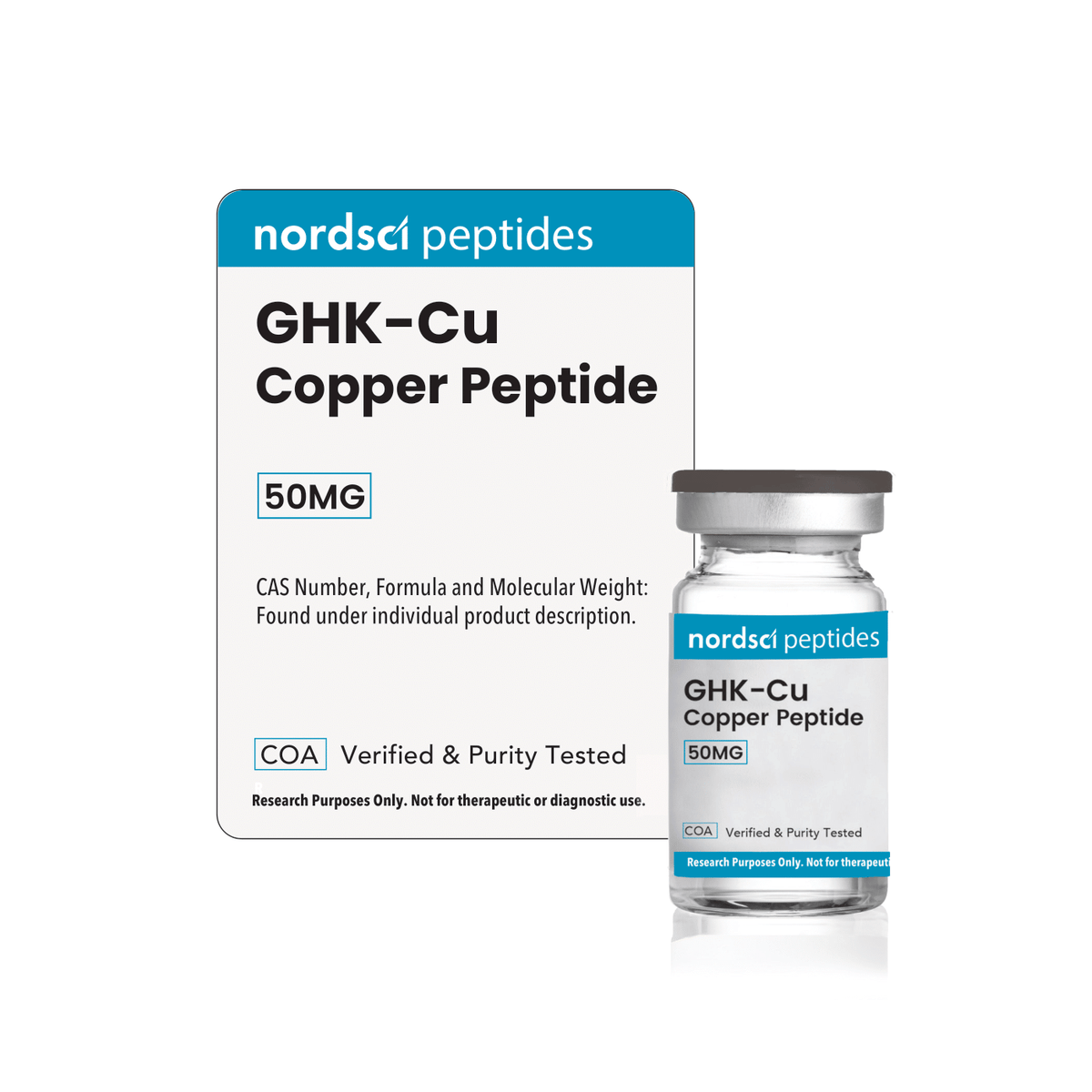
More about GHK Basic (50mg)
GHK Basic (50mg) contains the synthetic tripeptide Glycyl-L-Histidyl-L-Lysine in lyophilized powder form. It is supplied for controlled in vitro laboratory research, analytical evaluation, and experimental work involving tripeptide chemistry, molecular binding behavior, and peptide-metal coordination.
Nordsci GHK Basic is supplied exclusively as a research material. Lot-specific analytical documentation is available for laboratory review. This product is not a medicine, drug, food, cosmetic, dietary supplement, or consumer product.
For laboratory research use only. Not for human or animal consumption.
GHK Basic (50mg) Research Specifications:
| Compound |
GHK |
| Full Name |
Glycyl-L-Histidyl-L-Lysine |
| Unit Size |
50 mg/vial |
| Unit Quantity |
1 vial |
| Sequence |
Gly–His–Lys |
| Molecular Formula |
C14H24N6O4 |
| Molecular Weight |
Approximately 340.38 g/mol |
| CAS Number |
49557-75-7 |
| Compound Type |
Synthetic tripeptide |
| Appearance |
Lyophilized powder |
| Source |
Chemical synthesis |
| Purity and Identity |
Lot-specific; refer to the applicable Certificate of Analysis |
| Analytical Testing |
Review the batch-specific Certificate of Analysis for reported methods and results |
| Documentation |
Lot-specific Certificate of Analysis available |
| Storage Conditions |
Store sealed in a cool, dry, temperature-controlled laboratory environment protected from heat, light, and moisture. Consult the product label and lot-specific documentation for applicable storage requirements. |
| Research Use Only |
For laboratory research use only. Not for human or animal consumption or for diagnostic, therapeutic, veterinary, food, cosmetic, or dietary-supplement use. |
Technical identifiers may depend on the exact compound form supplied. Confirm all specifications against the lot-specific Certificate of Analysis before beginning laboratory work.
What Is GHK? Research Background
GHK is a tripeptide composed of the amino acids glycine, histidine, and lysine. Its short amino-acid sequence makes it relevant to laboratory investigations examining peptide structure, chemical behavior, molecular recognition, chromatographic separation, and mass-spectrometric identification.
The uncomplexed GHK sequence has been identified in biological samples. Synthetic GHK Basic provides laboratories with a standardized research material for controlled biochemical assays and analytical procedures. GHK Basic should be distinguished from GHK-Cu, which is the copper-coordinated form of the tripeptide.
Laboratory investigations may evaluate:
- Tripeptide identity and sequence characteristics
- Chromatographic separation and purity measurements
- Mass-spectrometric identification
- Molecular binding under defined assay conditions
- Peptide-metal coordination and complex formation
- Analytical method development and validation
Experimental conclusions must remain limited to the model, protocol, controls, and measurements used. Laboratory findings do not authorize clinical, consumer, veterinary, cosmetic, or dietary-supplement applications.
Important Research Notice: Lot-specific analytical documentation is available for GHK Basic. Researchers should verify that the lot number on the vial corresponds with the lot number shown on the applicable Certificate of Analysis.
THIS PRODUCT IS INTENDED EXCLUSIVELY FOR LABORATORY RESEARCH. NOT FOR HUMAN OR ANIMAL CONSUMPTION. NOT FOR DIAGNOSTIC, THERAPEUTIC, VETERINARY, FOOD, COSMETIC, OR DIETARY-SUPPLEMENT USE.
GHK – Key Research Applications
1. Peptide Identity and Purity Analysis
GHK Basic may be evaluated through analytical workflows designed to examine compound identity and lot-specific purity. Applicable procedures may include high-performance liquid chromatography, mass spectrometry, or other validated methods documented for the relevant research lot.
Researchers should retain the applicable analytical report with internal laboratory records when traceability and quality-control documentation are required.
2. Tripeptide Structure Research
Controlled laboratory research may examine the physicochemical characteristics of the Gly-His-Lys sequence. Experimental variables may include solvent system, temperature, pH, analytical platform, sample matrix, and other protocol-specific conditions.
Results should be interpreted only within the boundaries of the selected analytical method and experimental design.
3. Metal-Ion Coordination Studies
The histidine-containing GHK sequence may be used in controlled in vitro studies involving peptide-metal coordination, complex formation, and molecular binding under defined laboratory conditions.
Researchers should use appropriate controls and validated detection methods when comparing uncomplexed GHK with copper-coordinated or other metal-associated forms.
4. Analytical Method Development
GHK Basic may be incorporated into laboratory method-development procedures involving peptide separation, identification, detection, or comparative analysis. Method parameters should be documented and validated according to the requirements of the laboratory and selected analytical platform.
Experimental outcomes may vary according to assay design, instrument calibration, material concentration, sample preparation, environmental conditions, and control selection.
Handling and Research Use Considerations
GHK Basic (50mg) should be handled only by qualified laboratory personnel using established procedures for research chemicals and peptide materials. Personnel should review the product label, Certificate of Analysis, Safety Data Sheet, and institutional requirements before beginning laboratory work.
Appropriate personal protective equipment, contamination controls, calibrated instruments, and documented environmental conditions should be used where required by the applicable laboratory protocol.
Protocol Design Considerations: Experimental results may vary according to assay design, analytical platform, material concentration, sample matrix, environmental conditions, and control selection. Researchers are responsible for establishing and validating procedures appropriate to their intended in vitro or analytical work.
No dosing, administration, preparation for consumption, or human or animal application guidance is provided.
GHK Basic (50mg) – Certificate of Analysis (COA)
Lot-specific Certificates of Analysis provide analytical information associated with individual GHK Basic product lots. Available documentation may include compound identity, reported purity, and the analytical methods used for evaluation.
Researchers should confirm that the lot number shown on the product vial corresponds with the lot number shown on the selected COA. The applicable report should be retained with laboratory records when traceability and documentation are required.
View the GHK Basic Certificate of Analysis
Where to Buy GHK Basic for Research
Research laboratories sourcing GHK Basic should evaluate compound identity, amount per vial, lot traceability, storage requirements, packaging, analytical methods, and access to batch-specific documentation. Procurement decisions should be based on the technical requirements of an authorized laboratory protocol.
Nordsci supplies GHK Basic (50mg) exclusively for in vitro laboratory research and analytical evaluation. Consumer, clinical, veterinary, therapeutic, food, cosmetic, and dietary-supplement uses are prohibited.
How to Source GHK Basic for Laboratory Research
Before procurement, confirm the compound name, sequence, molecular formula, molecular weight, CAS number, amount per vial, purity information, testing documentation, storage requirements, and research-use designation.
GHK Basic Research Peptide Pricing Considerations
Research-material pricing may vary according to the amount supplied, synthesis requirements, analytical testing, packaging, documentation, and order volume. Laboratories should compare documented product specifications and lot-specific testing information when evaluating suppliers.
Research Institution Procurement and Compliance
Procurement personnel and principal investigators should ensure that acquisition complies with institutional purchasing policies, chemical inventory requirements, laboratory procedures, and applicable regulations. Access should be limited to qualified personnel, and the material should remain clearly labeled during storage and laboratory handling.
IMPORTANT: GHK Basic (50mg) is sold exclusively for in vitro laboratory research and analytical applications. It is not approved or supplied for human use, animal use, clinical protocols, diagnostic procedures, therapeutic applications, veterinary applications, food use, cosmetic use, or dietary-supplement use. No dosing, administration, or application guidance is provided.
Scientific References
-
Pickart L, Vasquez-Soltero JM, Margolina A. International Journal of Molecular Sciences. 2018.
-
Pickart L, Margolina A. Oxidative Medicine and Cellular Longevity. 2012.
Researchers should also consult the lot-specific Certificate of Analysis, applicable Safety Data Sheet, validated chemical databases, and current peer-reviewed analytical literature relevant to GHK peptide chemistry.
ALL ARTICLES AND PRODUCT INFORMATION PROVIDED ON THIS WEBSITE ARE FOR INFORMATIONAL AND EDUCATIONAL PURPOSES ONLY.
The products offered on this website are supplied exclusively for in vitro laboratory research conducted outside the body. These products are not medicines, drugs, cosmetics, foods, or dietary supplements and have not been approved for diagnostic, therapeutic, clinical, veterinary, cosmetic, food, or dietary-supplement use. Introduction into humans or animals is strictly prohibited.