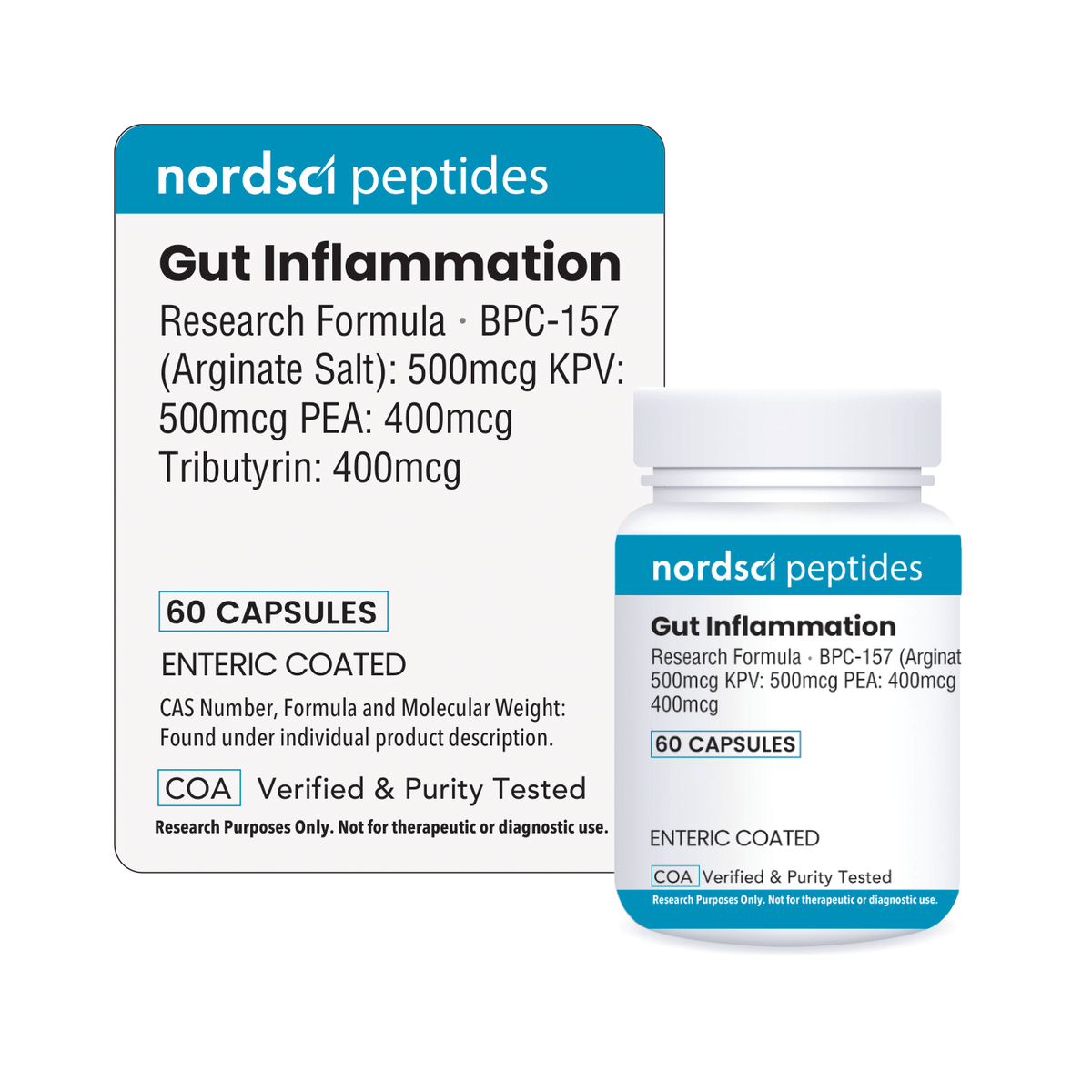
Gut Inflammation Capsules – Product Description
Gut Inflammation Capsules are an encapsulated, multi-component research formulation containing BPC-157, KPV,
palmitoylethanolamide (PEA), and Tributyrin. Each compound retains its individual chemical identity within the
formulation. This product is supplied exclusively for controlled laboratory analysis, method development, and
in-vitro research.
The formulation is intended for qualified researchers evaluating multi-component samples under controlled
analytical conditions. Applicable laboratory activities may include identity confirmation, constituent
characterization, stability testing, comparative assay development, and the measurement of predefined
molecular or biochemical endpoints.
Because this product contains multiple research compounds, the complete formulation does not have a single
molecular formula, molecular weight, CAS number, or peptide sequence. Researchers should consult the
applicable lot-specific Certificate of Analysis and supporting documentation for available specifications
and analytical results.
Gut Inflammation Capsules – Research Specifications:
| Product Name |
Gut Inflammation Capsules |
| Format |
Encapsulated research formulation |
| Formula Components |
BPC-157, KPV, PEA, and Tributyrin |
| Chemical Classification |
Multi-component formulation containing peptide and non-peptide research compounds |
| Molecular Formula |
No single molecular formula applies to the complete formulation |
| Molecular Weight |
No single molecular weight applies to the complete formulation |
| CAS Number |
No single CAS number applies to the complete formulation |
| Peptide Sequence |
Component-specific; consult available technical documentation |
| Appearance |
Capsule format |
| Purity / Identity |
Refer to the lot-specific Certificate of Analysis for applicable analytical documentation |
| Storage Conditions |
Store sealed in a cool, dry environment protected from heat, direct light, humidity, and moisture |
| Research Use Only |
Supplied exclusively for controlled laboratory research. Not for human or animal consumption or in-vivo use. |
What Are Gut Inflammation Capsules? Research Background and Mechanistic Context
Gut Inflammation Capsules are a multi-component laboratory material designed for controlled analytical and
in-vitro research. The formulation combines two peptide-based compounds with two chemically distinct
non-peptide compounds, allowing qualified researchers to examine the material using predefined laboratory
methods.
BPC-157 and KPV are peptide-based research compounds. PEA is a fatty acid amide, while Tributyrin is a
triacylglycerol compound. The inclusion of chemically distinct constituents requires researchers to select
analytical procedures appropriate for each component and the formulation as a whole.
Research involving multi-component formulations requires carefully defined controls because each constituent
can introduce separate analytical variables. Suitable study designs may include validated reference standards,
negative and positive controls, predetermined assay conditions, documented sample-preparation procedures, and
component-specific analytical methods.
Researchers conducting comparative analytical work with an individual component may also review
BPC-157. Parallel evaluation of individual
reference materials may assist laboratories with method specificity, constituent attribution, stability
assessment, and matrix-effect analysis.
Important Research Notice: Lot-specific Certificates of Analysis provide the applicable
analytical documentation for the supplied research material. Researchers should verify product identity,
lot information, storage requirements, and available test results before beginning laboratory work.
THIS PRODUCT IS INTENDED EXCLUSIVELY FOR LABORATORY RESEARCH. NOT FOR HUMAN OR ANIMAL CONSUMPTION.
NOT FOR IN-VIVO, CLINICAL, VETERINARY, DIAGNOSTIC, THERAPEUTIC, PREVENTIVE, FOOD, DRUG, DIETARY-SUPPLEMENT,
OR COSMETIC USE.
Gut Inflammation Capsules – Key Research Applications
1. Gut Barrier Integrity and Permeability-Adjacent Research
This formulation may be evaluated in controlled in-vitro assay systems designed to measure predefined
biochemical or molecular endpoints associated with gastrointestinal research models. Experimental
interpretation should remain limited to the validated scope and limitations of the selected assay.
The material must not be used to make claims regarding human gastrointestinal function, symptom relief,
barrier restoration, disease management, or therapeutic outcomes.
2. Inflammatory Signaling and Immune-Adjacent Pathway Studies
Qualified laboratories may use the formulation in controlled in-vitro experiments involving predefined
signaling markers or assay targets. Appropriate controls are required to distinguish formulation-level
observations from measurements associated with individual constituents or the experimental matrix.
Findings from laboratory assays must not be interpreted as evidence that the product changes inflammation,
immune function, infection response, or disease outcomes in humans or animals.
3. Short-Chain Fatty Acid (SCFA) and Microbiome Metabolite Research
Tributyrin may be examined as an individual constituent within analytical or in-vitro research involving
predefined metabolite-related measurements. Experimental procedures should account for matrix composition,
compound stability, assay specificity, reference standards, and the limitations of the selected model.
This research context does not establish suitability for dietary, nutritional, microbiome, gastrointestinal,
clinical, or therapeutic use.
4. Multi-Input GI Research With Controlled Attribution
The formulation may be used in comparative laboratory designs that evaluate a multi-component sample alongside
individual reference compounds, vehicle controls, or other defined research materials. This approach may assist
with analytical attribution and method validation when supported by suitable controls.
Laboratories should document sample identity, preparation procedures, analytical conditions, instrument
settings, acceptance criteria, and protocol deviations to maintain traceability and reproducibility.
Handling and Research Use Considerations
Gut Inflammation Capsules should be handled only by qualified personnel in an appropriately equipped
laboratory. Researchers should follow applicable institutional requirements, chemical-hygiene procedures,
personal-protective-equipment policies, and material-handling SOPs.
Keep the original container sealed when it is not being accessed. Record the product lot number, receipt date,
storage location, and handling history in laboratory documentation. Prevent cross-contamination by using clean
equipment and designated work areas appropriate for the analytical procedure.
The capsule presentation is a research-material format and must not be interpreted as a consumer dosage form.
Do not consume, administer, dispense, prescribe, compound, or apply the material to humans or animals. NordSci
does not provide dosing, administration, injection, consumption, or clinical-application guidance.
Protocol Design Considerations: Multi-component research materials may produce matrix effects
or overlapping analytical signals. Researchers should use appropriate controls, validated methods, predefined
acceptance criteria, and constituent-specific reference materials when necessary.
Note: This information is provided solely to identify the product and describe permissible laboratory
research contexts. All research must be performed by qualified personnel in accordance with applicable laws,
institutional policies, and laboratory procedures.
Gut Inflammation Capsules – Certificate of Analysis (COA)
Each available lot of Gut Inflammation Capsules is accompanied by analytical documentation identifying the
tested research material and reporting applicable quality parameters. The Certificate of Analysis should be
matched to the lot number displayed on the product container.
COA documentation may be used to support laboratory procurement, receiving inspection, material
identification, quality-control review, and research traceability. Researchers remain responsible for
determining whether the documented specifications are appropriate for their intended analytical method.
Testing methods and reported results may vary by product and lot. Consult the applicable certificate for the
specific analytical methods, specifications, and results associated with the supplied material.
Where to Buy Gut Inflammation Capsules for Research Purposes
Gut Inflammation Capsules are available from NordSci Peptides exclusively as a laboratory research material.
Procurement teams should review the product label, lot-specific Certificate of Analysis, storage information,
and institutional requirements before ordering or accepting the material.
The product is not a drug, dietary supplement, food, cosmetic, medical product, or veterinary product. Its
capsule format does not indicate suitability for consumption or administration.
IMPORTANT: Gut Inflammation Capsules are supplied exclusively for controlled laboratory
research. They are not approved for human or animal consumption, in-vivo procedures, clinical use, veterinary
use, diagnosis, treatment, disease prevention, food use, dietary-supplement use, or cosmetic use. Purchasers
and researchers are responsible for compliance with all applicable laws, regulations, institutional policies,
and laboratory requirements.
Scientific References
- Lot-specific Certificate of Analysis for Gut Inflammation Capsules.
- Applicable laboratory SOPs for receiving, identifying, storing, and handling encapsulated research materials.
- Validated analytical-method documentation used by the laboratory for identity, purity, stability, or constituent-specific testing.
- Applicable institutional policies governing in-vitro research materials and multi-component analytical samples.