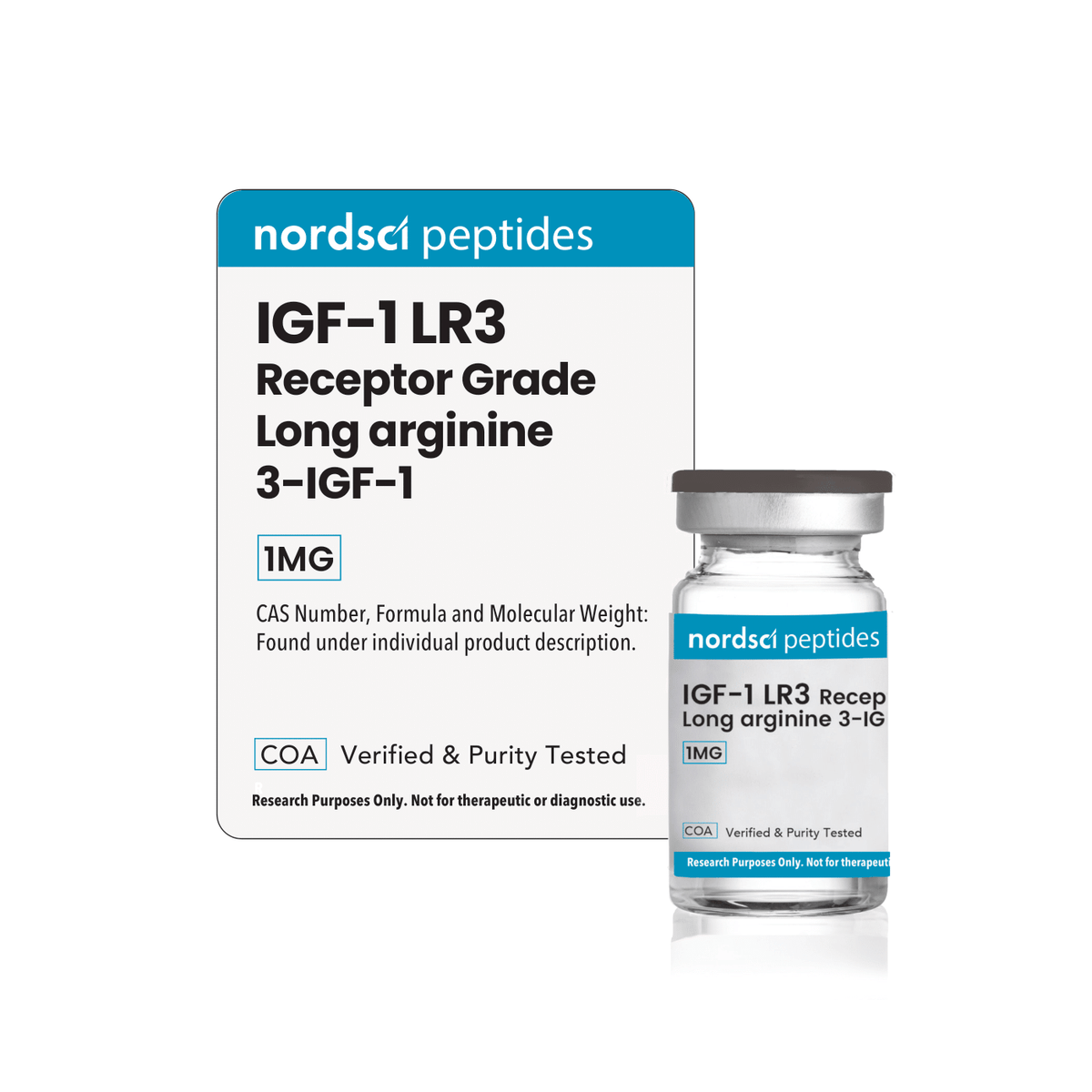
More about IGF-1 LR3 (1mg)
IGF-1 LR3 is a modified IGF-1 analogue supplied exclusively as a laboratory research material. Its structural characteristics make it suitable for controlled in vitro studies comparing receptor interactions, ligand-binding behavior, signaling duration, and assay responses associated with the IGF-1 receptor pathway.
The material is supplied as a lyophilized powder. Lot-specific analytical documentation is available for laboratory quality-control records, procurement files, protocol documentation, inventory management, and material traceability.
IGF-1 LR3 Research Peptide Specifications:
| Product Name |
IGF-1 LR3 |
| Unit Size |
1mg per vial |
| Unit Quantity |
1 vial |
| Molecular Formula |
Refer to current product documentation |
| Molecular Weight |
Refer to current product documentation |
| CAS Number |
Refer to current product documentation |
| Sequence |
Long R3 analogue of IGF-1; refer to current product documentation for sequence information |
| Form |
Lyophilized powder |
| Source |
Chemical synthesis |
| Purity (HPLC) |
See the lot-specific Certificate of Analysis |
| Identity Verification |
See the lot-specific Certificate of Analysis for mass spectrometry and method details |
| Storage Conditions |
Store at −20°C or below, protected from light and moisture |
| Testing Documentation |
Batch-specific Certificate of Analysis available |
| Research Classification |
Laboratory research use only |
| Restrictions |
Not for human or animal consumption, human or animal in vivo procedures, diagnostic use, therapeutic use, veterinary use, food use, cosmetic use, or supplement use |
What Is IGF-1 LR3? Research Background and Mechanism
IGF-1 LR3 is a laboratory analogue of insulin-like growth factor 1. Its modified structure is examined in controlled research involving IGF-1 receptor interactions, ligand-binding characteristics, and downstream signal-transduction pathways.
In vitro studies may use IGF-1 LR3 as a reference material when comparing native and modified IGF-related compounds. Laboratory variables may include receptor-binding measurements, concentration-dependent assay responses, exposure intervals, phosphorylation markers, protein-expression measurements, and other protocol-defined endpoints.
IGF-1 LR3 may also be included in comparative assay designs evaluating how structural differences influence ligand behavior under standardized laboratory conditions. Reproducible research requires suitable controls, validated analytical methods, documented storage, and consistent material handling.
Important Research Notice: Each lot is subject to independent third-party analytical testing. Available documentation may include HPLC purity analysis and mass spectrometry identity verification. Consult the lot-specific Certificate of Analysis for confirmed results and testing methods.
THIS PRODUCT IS INTENDED EXCLUSIVELY FOR LABORATORY RESEARCH. NOT FOR HUMAN OR ANIMAL CONSUMPTION OR IN VIVO PROCEDURES. NOT FOR DIAGNOSTIC, THERAPEUTIC, VETERINARY, FOOD, COSMETIC, OR SUPPLEMENT USE.
IGF-1 LR3 Research: Key Laboratory Applications
1. IGF Receptor Signaling and Downstream Pathway Mapping
IGF-1 LR3 may be evaluated in controlled in vitro assays examining IGF-1 receptor interactions and downstream signaling events. Laboratory measurements may include phosphorylation status, pathway-associated protein expression, transcriptional responses, and time-dependent assay changes.
Protocols should incorporate appropriate controls, defined exposure conditions, and validated detection methods. Results must remain limited to the selected laboratory model and analytical procedures.
2. Protein Synthesis Markers and Cellular Growth-Response Models
Laboratory studies may use IGF-1 LR3 to examine pathway-associated protein synthesis markers and cellular assay measurements under controlled culture conditions. Research variables may include exposure duration, concentration range, cell type, media composition, culture density, and baseline assay conditions.
Standardized controls are necessary to account for serum composition, cell-cycle status, culture conditions, and other variables that may influence the measured data.
3. Tissue-Level Growth-Factor Biology and Laboratory Research Endpoints
IGF-1 LR3 may be included in ex vivo or laboratory tissue assays examining receptor-level interactions and related molecular markers. Applicable endpoints may include receptor binding, pathway activation, transcriptional changes, protein-expression measurements, and laboratory-defined structural observations.
Separate experimental groups and appropriate controls should be established when comparing IGF-1 receptor activity with other signaling systems. This reduces confounding variables and improves data interpretation within the selected research model.
4. Comparative Signaling Studies Within Multi-Compound Research Programs
IGF-1 LR3 may serve as a reference or comparator material in multi-compound in vitro studies. These experiments may evaluate differences in receptor-binding characteristics, signaling duration, pathway selectivity, and assay responses across individual research compounds.
Material identity, lot traceability, storage records, and standardized analytical procedures are essential when comparing results across study phases. Each research material should be evaluated independently before additional experimental variables are introduced.
IGF-1 LR3 Certificate of Analysis (COA) – Lab Testing
Each lot of IGF-1 LR3 is accompanied by a Certificate of Analysis documenting the available analytical results. Depending on the lot and testing protocol, documentation may include:
- HPLC purity analysis
- Mass spectrometry identity verification
- Batch or lot identification
- Analytical method information
- Testing date and laboratory documentation
- Product appearance and material classification
The applicable COA should be retained with procurement records, inventory documentation, protocol files, and internal laboratory quality-control records.
Where to Buy IGF-1 LR3 for Research Purposes
Laboratories sourcing IGF-1 LR3 should evaluate product labeling, lot identification, storage information, analytical testing, documentation availability, and material traceability.
NordSci Peptides supplies IGF-1 LR3 as a laboratory research material with independent third-party testing and lot-specific COA documentation. The product is intended exclusively for qualified laboratory, analytical, and institutional research settings.
IMPORTANT: IGF-1 LR3 is not a drug, dietary supplement, food, cosmetic, or medical product. It is not intended for human or animal consumption, human or animal in vivo procedures, diagnostic use, therapeutic use, or veterinary use. Laboratories are responsible for complying with applicable laws, institutional requirements, and established safety procedures.
Scientific References
- Research characterizing IGF-1 receptor structure, ligand binding, and intracellular signal-transduction pathways.
- Laboratory studies examining modified IGF-1 analogues and their binding characteristics in controlled experimental systems.
- In vitro assay methodologies addressing receptor activation, phosphorylation markers, and comparative ligand-response measurements.
- Analytical methods for assessing peptide identity and purity through high-performance liquid chromatography and mass spectrometry.
- Laboratory quality-control standards addressing lot traceability, material storage, analytical documentation, and protocol records.
Related Research Resources