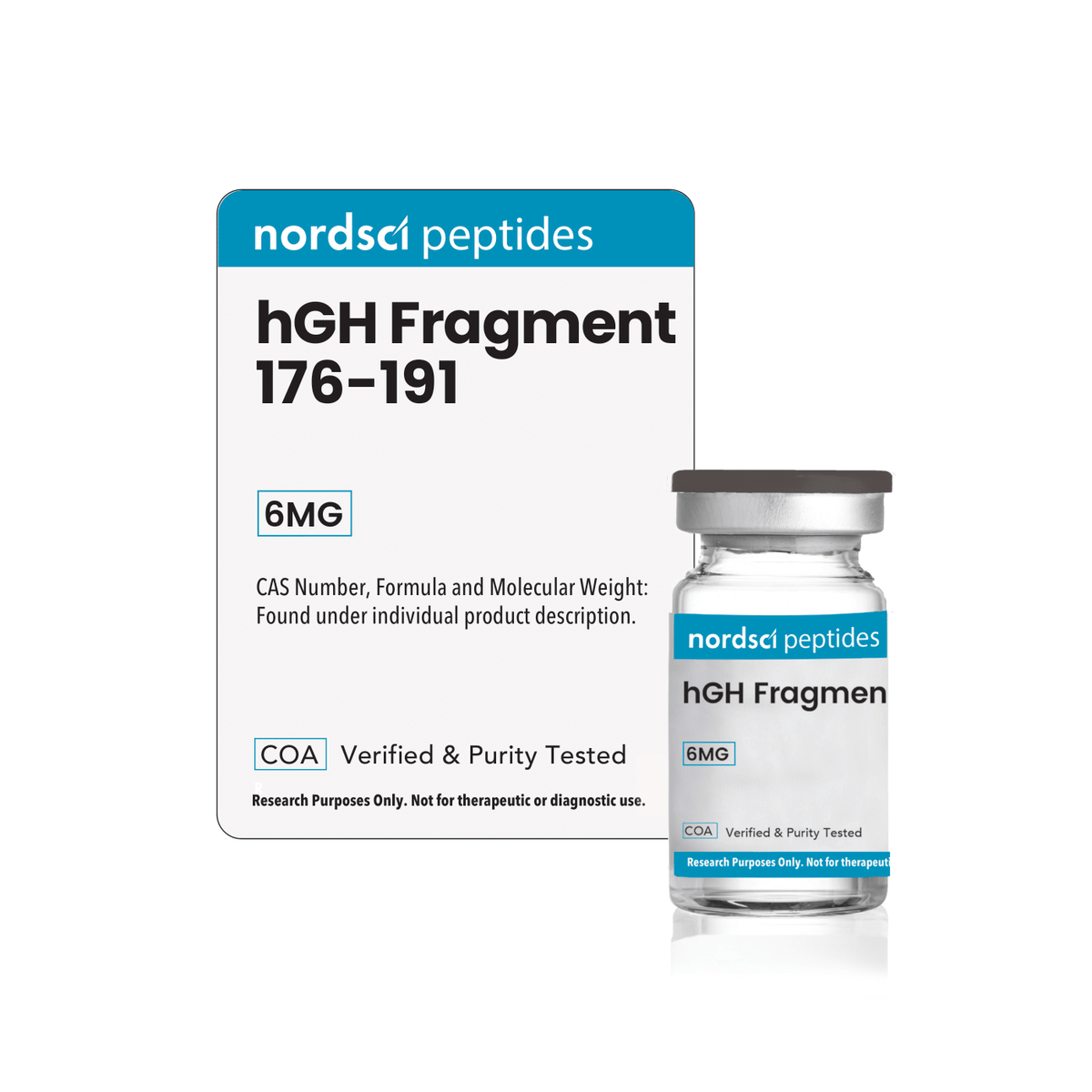
More about Frag 176-191 (6mg)
Frag 176-191, also known as Frag 176-191, is a high-purity research peptide corresponding to the C-terminal segment of human growth hormone associated with lipolytic signaling. This fragment is synthesized for controlled laboratory studies evaluating fat metabolism, energy balance, and receptor-mediated signaling pathways in preclinical research models.
Because this peptide isolates a specific region of the broader molecule, it is frequently used in protocols designed to separate metabolic signaling effects from wider somatotropic activity. Teams building broader study frameworks often also review Nordsci resources on full-length research comparisons, multi-compound peptide stack design, and research procurement and sourcing consistency when mapping metabolic and body-composition studies.
Frag 176-191 Research Peptide Specifications:
| Unit Size | 6mg/vial |
| Unit Quantity | 1 vial |
| Purity (HPLC) | > 99% |
| Sequence | Phe–Leu–Arg–Ile–Val–Gln–Cys–Arg–Ser–Val–Glu–Gly–Ser–Cys–Gly–Phe |
| Molecular Formula | C78H123N23O22S2 |
| Molecular Weight | ≈ 1,799.1 g/mol |
| CAS Number | 66004-57-7 |
| Appearance | Lyophilized white powder |
| Source | Chemical synthesis |
| Storage Conditions | Store lyophilized Frag 176-191 at -20 °C, protected from light and moisture. Reconstituted peptide may be stored at 4 °C for short-term research use. |
| Research Use Only | This research peptide is intended for laboratory research use only. Not for human consumption or therapeutic use. |
What Is Frag 176-191? Research Background and Mechanism
Frag 176-191 is a synthetic peptide corresponding to amino acids 176–191 of the human growth hormone molecule. This C-terminal region has been identified in preclinical studies as a key segment associated with lipolytic and anti-lipogenic activity, distinct from the broader somatotropic effects of full-length human growth hormone.1,2
By isolating this specific region, researchers can interrogate fat-metabolism pathways without engaging the full spectrum of growth hormone signaling. In rodent and cell-culture models, synthetic fragments derived from this domain have been investigated for their impact on lipid mobilization, fatty-acid oxidation, and adipocyte signaling cascades under controlled conditions.2,3
Laboratory data suggest that Frag 176-191 may selectively engage lipolytic pathways, supporting investigations into how this region of interfaces with beta-adrenergic signaling, cyclic AMP production, and downstream protein kinase A mediated events in adipose tissue. This makes Frag 176-191 a useful probe for dissecting the mechanistic separation between growth, metabolic, and body-composition related signaling modes in preclinical research.
In parallel, in silico and in vitro work has explored potential roles for C-terminal fragments in broader contexts such as cellular stress responses, experimental oncology models, and combination strategies with delivery platforms to deepen understanding of receptor binding and combinatorial signaling effects in mammalian systems.1 Researchers comparing these pathways against broader metabolic frameworks may also review Nordsci’s advanced metabolic peptide research article for additional study-design context.
Important Research Notice: Nordsci research peptides are manufactured under stringent quality-control processes and verified by independent third-party analytical testing. Each lot is supported by Certificate of Analysis documentation detailing identity and purity metrics for laboratory use.
THIS PRODUCT IS INTENDED FOR LABORATORY RESEARCH USE ONLY. NOT FOR HUMAN CONSUMPTION. NOT INTENDED TO DIAGNOSE, TREAT, CURE, OR PREVENT ANY DISEASE OR CONDITION.
Frag 176-191 Research Protocol and Reconstitution
Reconstitution Guidelines for Laboratory Use:
For typical research applications, researchers may reconstitute each 6mg vial of Frag 176-191 with sterile bacteriostatic water to achieve the desired working concentration for experimental protocols.
Research Reference Considerations: Published studies have leveraged various concentration ranges and exposure schedules when evaluating fragments in adipose tissue, metabolic, and cell-culture models. Laboratories should align test conditions with institutional protocols, species-specific guidelines, and current literature when designing experiments.
Note: The information above is provided for scientific context only. All work must be conducted by qualified personnel in appropriately equipped facilities operating under applicable animal-care, biosafety, and institutional review requirements.
Frag 176-191 Research Focus Areas
Lipid Metabolism and Energy Balance: Frag 176-191 is widely used in preclinical research focused on lipolysis, lipogenesis, and adipocyte biology. Studies with related fragments have explored weight-change dynamics, shifts in adipose-tissue gene expression, and modulation of beta3-adrenergic receptor linked pathways in rodent models of obesity and metabolic dysfunction.2,3
Metabolic Signaling and Receptor Selectivity: Because Frag 176-191 isolates a functionally distinct domain of the molecule, it enables researchers to examine how selective activation of lipolytic signaling compares to full-length exposure. Experimental work has looked at changes in cyclic AMP signaling, free-fatty-acid release, and downstream markers of metabolic stress across a range of preclinical systems.
Emerging and Exploratory Models: More recent investigations have evaluated fragments in combination with delivery platforms such as nanoparticles and in specialized in vitro disease models, including oncology-focused cell lines. These studies are exploratory and are designed to map mechanistic interactions and potential research applications, not to define therapeutic indications.1
For labs building larger body-composition or endocrine study programs, the operational advantage of Frag 176-191 is often its relative specificity within a broader growth-hormone related ecosystem. That is why many teams also standardize sourcing, documentation, and comparator selection before scaling cohort size.
Certificate of Analysis and Quality Assurance
Each Frag 176-191 lot is supported by analytical testing for identity and purity using techniques such as high-performance liquid chromatography and mass spectrometry. For the most current COA and testing details associated with a specific lot, qualified research customers may contact Nordsci Peptides support or reference the documentation supplied with their shipment.
Where to Buy Frag 176-191 for Research Purposes
Laboratories seeking Frag 176-191 for metabolic and body-composition research should source peptides from suppliers that prioritize analytical transparency and research-grade manufacturing practices. Nordsci Peptides provides high-purity synthetic peptides with robust documentation and batch-level quality data for institutional and professional research teams.
Research Sourcing Considerations:
When procuring Frag 176-191 or other fragments, research groups should confirm that the supplier provides lot-specific COA documentation, purity reporting and identity confirmation, clear storage and handling guidance for lyophilized and reconstituted material, and an explicit research use only designation aligned with institutional compliance requirements.
Compliance Reminder: Frag 176-191 is supplied exclusively for in vitro and preclinical research applications. It is not approved for human or veterinary use, clinical protocols, or any form of therapeutic administration.
Related Research Articles