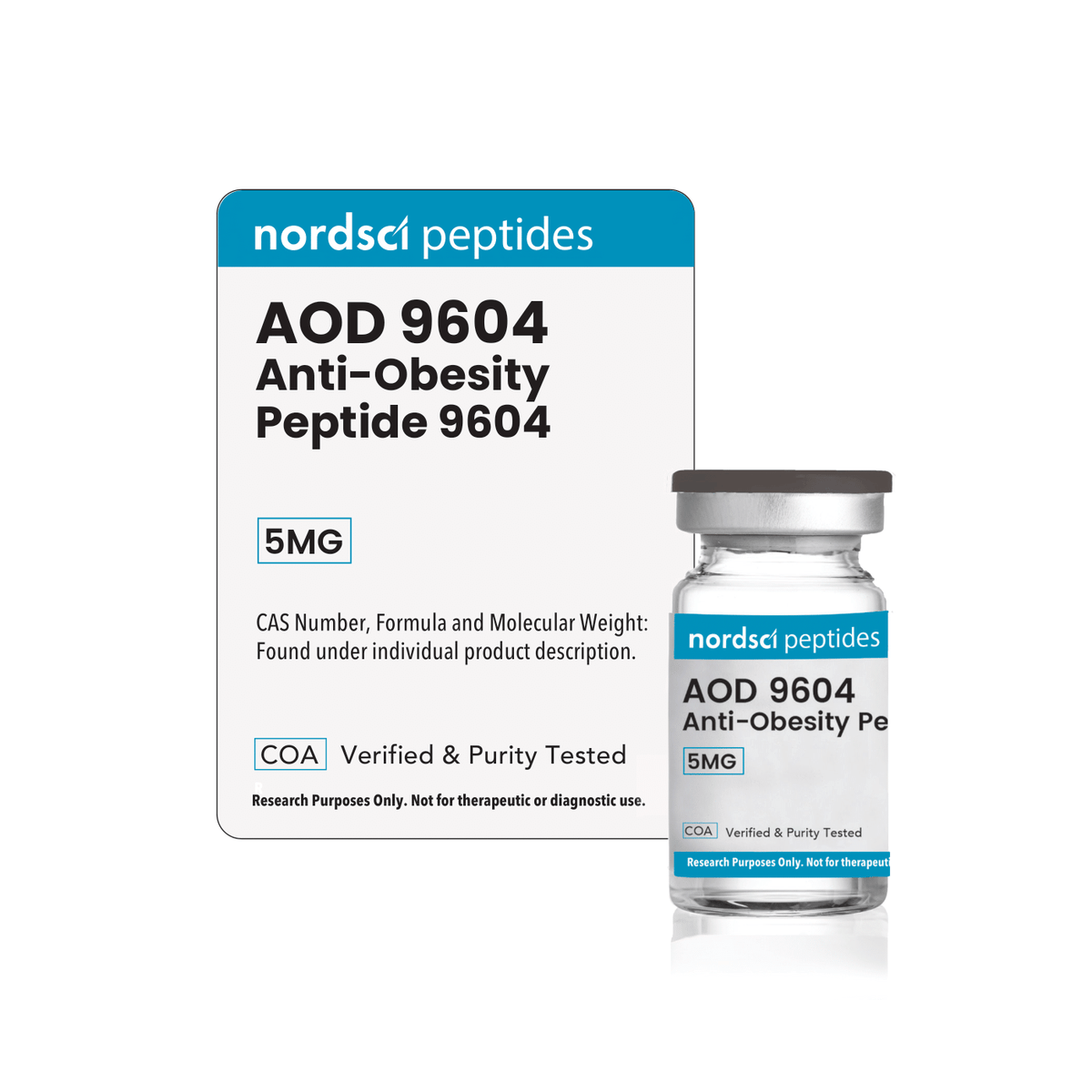
More about AOD-9604 (5mg)
AOD-9604 is a synthetic research peptide corresponding to a modified C-terminal fragment of human growth hormone. The compound is intended for controlled in vitro research involving peptide-fragment characterization, molecular interaction assays, analytical method development, and pathway-specific laboratory evaluation.
AOD-9604 is supplied as a research-grade lyophilized material. Each lot is evaluated through independent analytical testing, with batch-specific documentation available through the Nordsci Peptides COA Library.
AOD-9604 (5mg) – Research Specifications:
| Compound |
AOD-9604 |
| Quantity |
5mg per vial |
| Compound Type |
Synthetic peptide fragment derived from hGH 176-191 |
| Purity / Identity |
Refer to the lot-specific Certificate of Analysis |
| Sequence |
Tyr-Leu-Arg-Ile-Val-Gln-Cys-Arg-Ser-Val-Glu-Gly-Ser-Cys-Gly-Phe |
| Molecular Formula |
C78H123N23O23S2 |
| Molecular Weight |
Approximately 1815.1 g/mol |
| CAS Number |
221231-10-3 |
| Appearance |
Lyophilized white powder |
| Source |
Chemical synthesis |
| Storage Conditions |
Store at -20°C or below, protected from light and moisture. Follow the lot-specific COA and institutional storage procedures. |
| Analytical Testing |
Independent HPLC and mass spectrometry testing with batch-specific documentation |
| Research Use Only |
For controlled in vitro laboratory research and analytical testing only. Not for human or animal consumption or use. |
What Is AOD-9604? Research Background and Mechanism
AOD-9604 is a defined peptide fragment corresponding to the 176-191 region of human growth hormone with an additional N-terminal tyrosine. The sequence contains two cysteine residues capable of forming an intramolecular disulfide bridge.
Unlike full-length human growth hormone, AOD-9604 can be evaluated as an isolated peptide fragment in controlled laboratory systems. This distinction allows researchers to examine fragment-specific molecular characteristics without introducing the complete structure of the parent hormone.
Laboratory applications may include structural characterization, chromatography, mass spectral confirmation, degradation analysis, target-interaction screening, and comparative signal-response assays. Experimental findings remain specific to the conditions, controls, materials, and analytical methods used.
Important Research Notice: Nordsci Peptides uses independent analytical testing to evaluate lot-specific identity and purity through HPLC and mass spectrometry. The applicable Certificate of Analysis provides the reported results for each batch.
THIS PRODUCT IS INTENDED EXCLUSIVELY FOR CONTROLLED IN VITRO LABORATORY RESEARCH. NOT FOR HUMAN OR ANIMAL CONSUMPTION OR USE. NOT FOR VETERINARY, CLINICAL, DIAGNOSTIC, OR THERAPEUTIC APPLICATIONS.
AOD-9604 Peptide Research: Key Laboratory Applications
1. Lipid Metabolism and Adipose Tissue Research
AOD-9604 may be incorporated as a test article in controlled in vitro assays involving adipocyte-derived cell systems, isolated molecular targets, or biochemical markers associated with lipid-related signaling pathways.
Appropriate laboratory endpoints may include molecular binding, assay selectivity, marker expression, test-article stability, and comparative signal detection. Results from these systems are assay-specific and do not establish outcomes outside the laboratory environment.
2. Peptide-Fragment Signaling Models
Defined peptide fragments allow researchers to compare the laboratory behavior of an isolated sequence with that of a parent molecule, reference standard, or control material.
AOD-9604 may be evaluated through receptor-binding assays, cell-based screening platforms, biochemical pathway panels, and structure-activity investigations. Experimental protocols should include appropriate controls, validated analytical methods, and documented acceptance criteria.
3. Analytical Stability and Degradation Research
AOD-9604 can be examined in controlled laboratory matrices to characterize chromatographic behavior, mass spectral identity, degradation patterns, and sample stability under defined experimental conditions.
These studies may compare variables such as temperature, light exposure, storage interval, matrix composition, and analytical method. Findings should be documented within the laboratory’s quality-management system and interpreted only within the validated scope of the experiment.
4. Comparative and Multi-Analyte Research
Researchers may include AOD-9604 in comparative analytical panels involving other peptide fragments, reference materials, or molecular controls. These studies can examine differences in sequence, molecular weight, chromatographic retention, spectral identity, binding characteristics, or assay response.
Each material should be evaluated independently using validated methods. Comparative laboratory findings do not establish clinical equivalence, therapeutic utility, or suitability for human or animal use.
AOD-9604 Certificate of Analysis (COA) – Lab Testing
Each AOD-9604 lot is independently evaluated for identity and purity using analytical methods that may include high-performance liquid chromatography and mass spectrometry.
The lot-specific Certificate of Analysis identifies the tested batch, reported analytical results, and applicable testing methods. Researchers should review the COA before incorporating the material into an approved laboratory protocol.
Where to Source AOD-9604 for Research Purposes
AOD-9604 procurement should prioritize traceability, accurate labeling, lot identification, documented storage requirements, and access to batch-specific analytical results.
Nordsci Peptides supplies AOD-9604 as a research-grade lyophilized material intended exclusively for controlled in vitro laboratory research and analytical evaluation.
How to Source AOD-9604 for Laboratory Research
Before procuring AOD-9604, laboratories should verify clear compound identification, vial quantity, batch traceability, COA access, HPLC and mass spectrometry documentation, molecular specifications, storage requirements, and explicit research-use restrictions.
AOD-9604 Research Peptide Pricing Considerations
Research peptide pricing can vary according to vial quantity, synthesis complexity, analytical requirements, purity specifications, documentation, and procurement volume. Laboratories should evaluate the complete analytical and documentation package rather than relying exclusively on the listed per-vial price.
Research Institution Procurement and Compliance
AOD-9604 must be procured exclusively for controlled in vitro laboratory research under applicable institutional policies. Laboratories are responsible for maintaining appropriate purchasing, inventory, storage, access-control, and disposal records.
Nordsci Peptides does not provide instructions concerning dosing, administration, clinical application, or human or animal use.
IMPORTANT: AOD-9604 IS SOLD EXCLUSIVELY FOR CONTROLLED IN VITRO LABORATORY RESEARCH AND ANALYTICAL TESTING. IT IS NOT A DRUG, DIETARY SUPPLEMENT, FOOD, OR COSMETIC. IT IS NOT FDA-APPROVED FOR ANY USE. NOT FOR HUMAN OR ANIMAL CONSUMPTION OR USE. NOT FOR VETERINARY, CLINICAL, DIAGNOSTIC, OR THERAPEUTIC APPLICATIONS.
Scientific References
- Heffernan M, Summers RJ, Thorburn A, et al. Endocrinology. 2001;142(12):5182-5189. PMID: 11673763.
- Moré M, et al. Journal of Endocrinology and Metabolism. Published online 2014.
- Lot-specific AOD-9604 Certificate of Analysis, including HPLC and mass spectrometry documentation.
- Applicable public regulatory records concerning the investigational status of AOD-9604.
Related Research Resources