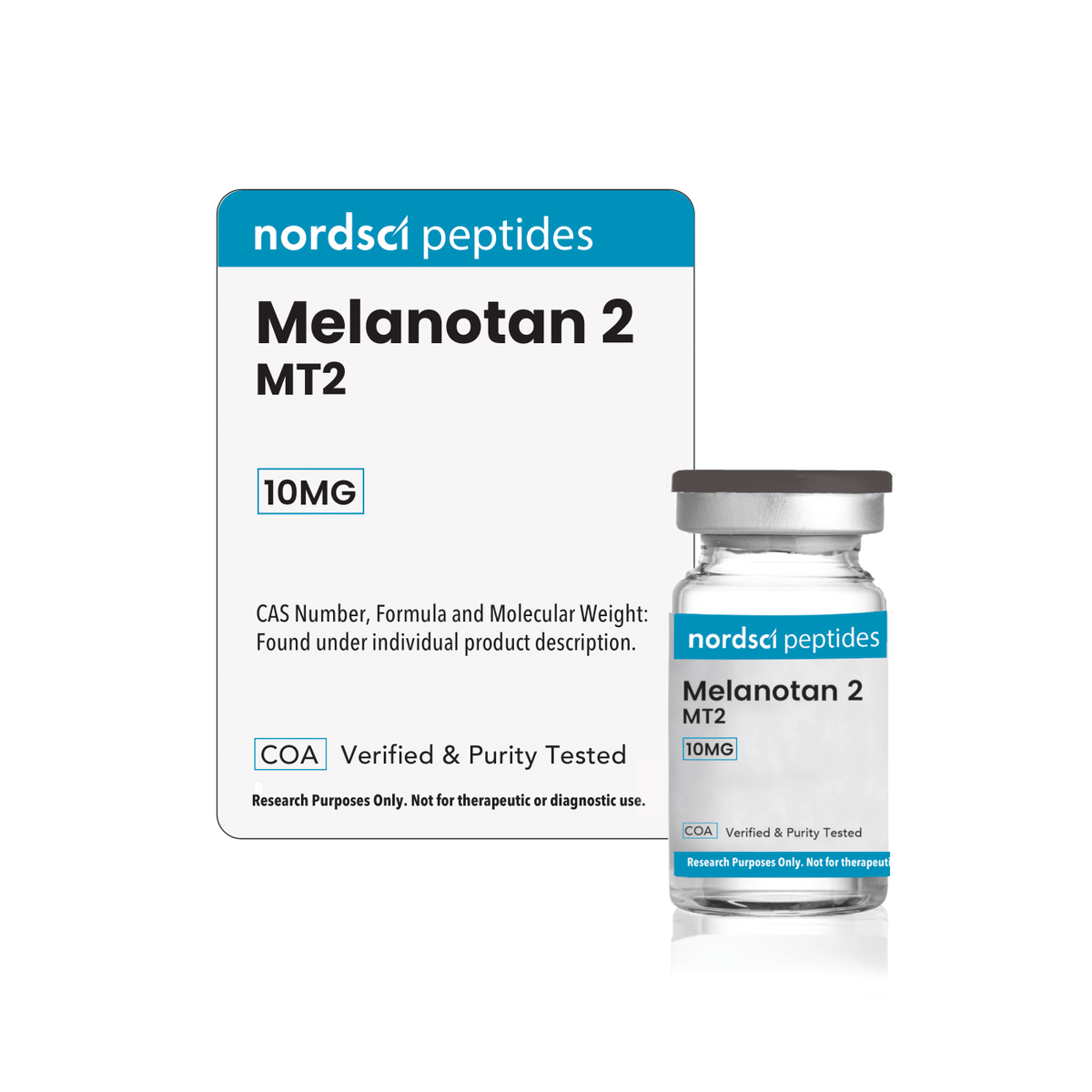
More about Melanotan II (10mg)
Melanotan II, commonly abbreviated MT-2, is a synthetic cyclic peptide supplied for controlled laboratory research and analytical evaluation. It is commonly examined in vitro in studies involving melanocortin receptor binding, receptor-mediated signaling, melanocyte-derived cellular models, and associated molecular-response assays.
MT-2 is connected to the alpha-melanocyte-stimulating hormone research lineage and provides laboratories with a defined compound for receptor characterization and comparative assay development. References to pigmentation or melanocyte activity identify experimental research categories only and do not represent cosmetic, therapeutic, or human-use claims.
Melanotan II Research Peptide Specifications:
| Unit Size |
10mg per vial |
| Unit Quantity |
1 vial |
| Sequence |
Ac-Nle-cyclo(-β-Asp-His-D-Phe-Arg-Trp-ε-Lys-NH2) |
| Molecular Formula |
C50H69N15O9 |
| Molecular Weight |
Approximately 1024.2 g/mol |
| CAS Number |
121062-08-6 |
| Form |
Lyophilized powder |
| Source |
Chemical synthesis |
| Purity / Identity |
Refer to the lot-specific Certificate of Analysis |
| Analytical Documentation |
Lot-specific documentation may report HPLC, mass spectrometry, or other applicable analytical results |
| Storage Conditions |
Store sealed at −20°C or below and protect from light, heat, and moisture unless otherwise stated in the applicable documentation |
| Research Classification |
Laboratory research and analytical use only |
| Restrictions |
Not for human or animal consumption or in vivo, diagnostic, therapeutic, food, drug, cosmetic, or dietary-supplement use |
What Is Melanotan II? Research Background and Mechanism
Melanotan II is a synthetic peptide used in controlled laboratory studies examining the melanocortin receptor system. Melanocortin receptors are G protein-coupled receptors that can be evaluated through receptor-binding assays, second-messenger measurements, and other defined analytical methods.
Laboratory research may examine MT-2 in connection with MC1R and other melanocortin receptor subtypes. Experimental endpoints can include receptor affinity, selectivity, concentration-dependent activity, intracellular signaling markers, and assay-specific cellular responses.
References to melanogenesis, pigmentation signaling, or melanocyte activity describe laboratory models and measurable experimental endpoints. They do not indicate that Melanotan II is intended to alter human or animal appearance, physiology, behavior, appetite, or any other outcome.
Experimental findings must be interpreted within the limitations of the selected model, controls, exposure conditions, analytical instrumentation, and acceptance criteria.
Important Research Notice: Nordsci research materials are supplied with access to lot-specific analytical documentation. Researchers should consult the applicable Certificate of Analysis for reported identity and purity information.
THIS PRODUCT IS INTENDED EXCLUSIVELY FOR LABORATORY RESEARCH. NOT FOR HUMAN OR ANIMAL CONSUMPTION. NOT FOR IN VIVO, DIAGNOSTIC, THERAPEUTIC, FOOD, DRUG, COSMETIC, OR DIETARY-SUPPLEMENT USE.
Melanotan II Research: Key Laboratory Applications
1. Pigmentation and Melanogenesis Research Models
Controlled in vitro studies may use MT-2 in melanocyte-derived experimental systems to observe predefined markers associated with melanocortin receptor activity and melanogenesis-related signaling.
Endpoints may include receptor engagement, intracellular messenger activity, enzyme-associated markers, or other measurements selected through validated laboratory procedures. Findings remain specific to the model and conditions used.
2. Skin-Related Signaling Pathways and Dermal Context Studies
MT-2 may be incorporated into laboratory models containing melanocyte-derived or other skin-associated cell types. These studies can help researchers distinguish melanocortin receptor activity from unrelated molecular pathways within a controlled experimental system.
References to skin or dermal models describe the source or classification of the experimental material. They do not indicate cosmetic use, tanning use, dermatological application, or an effect on human or animal tissue.
3. Melanocortin Receptor Biology and Binding Assays
Receptor-focused laboratories may use MT-2 to examine binding affinity, receptor selectivity, second-messenger activity, and concentration-dependent responses under standardized in vitro conditions.
Reliable interpretation requires appropriate controls, validated analytical methods, documented material identity, and consistent assay conditions. Researchers should avoid extending in vitro findings beyond the limitations of the experimental model.
4. Comparative Research Within Melanocortin-Related Study Programs
MT-2 may be included in comparative studies designed to distinguish the behavior of different melanocortin-related research compounds. Laboratories can evaluate compounds across consistent receptor panels, cell models, exposure periods, and analytical endpoints.
Comparative findings describe relative activity under the specified laboratory conditions. They do not establish clinical equivalence, therapeutic value, safety, or suitability for human or veterinary use.
Melanotan II Research Handling, Reconstitution, and Protocol Notes
Melanotan II should be handled only by qualified laboratory personnel using established procedures for synthetic peptide research materials. Laboratories should document product receipt, lot identification, storage conditions, sample allocation, analytical methods, and disposal.
No reconstitution volume, diluent selection, concentration, dosing, injection, administration, or in vivo application guidance is provided. Those subjects fall outside the intended scope of this research-material description.
Protocol design considerations include:
- Endpoint definition: Identify the receptor, molecular marker, or analytical measurement being evaluated.
- Control selection: Include appropriate positive, negative, vehicle, and baseline controls where applicable.
- Environmental consistency: Document light exposure, temperature, timing, and other variables that could influence the assay.
- Analytical validation: Use qualified methods and defined acceptance criteria appropriate to the experimental objective.
- Traceability: Record the product lot number and retain the associated COA with the experiment’s documentation.
- Interpretation limits: Restrict conclusions to the selected model, methods, controls, and observed laboratory results.
Note: This information is provided exclusively as a laboratory research reference. All work should be conducted by qualified personnel in appropriately equipped facilities and in accordance with applicable institutional requirements.
Melanotan II Certificate of Analysis (COA) – Lab Testing
Lot-specific Certificates of Analysis provide analytical information associated with the applicable Melanotan II product lot. Documentation may include identity, purity, testing methodology, and other reported analytical results.
Researchers should confirm that the lot number on the vial corresponds with the lot number shown on the applicable COA. Analytical findings apply only to the tested lot and should not be interpreted as evidence of clinical safety, effectiveness, or approval for human or veterinary use.
Where to Buy Melanotan II (10mg) for Research Purposes
Nordsci Peptides supplies Melanotan II (10mg) as a laboratory research material with access to lot-specific analytical documentation. Laboratories should evaluate compound identity, reported analytical results, storage requirements, batch traceability, and institutional procurement standards before use.
IMPORTANT: Melanotan II is sold exclusively for laboratory research and analytical use. It is not a drug, food, dietary supplement, cosmetic, or therapeutic product. It is not approved for human or veterinary use and must not be used for consumption, diagnosis, treatment, prevention, cosmetic application, or any in vivo procedure.
Scientific References
- Sawyer TK, et al. 4-Norleucine, 7-D-phenylalanine-α-melanocyte-stimulating hormone: a highly potent α-melanotropin with ultralong biological activity. Proceedings of the National Academy of Sciences. 1980.
- Mountjoy KG, Robbins LS, Mortrud MT, Cone RD. The cloning of a family of genes that encode the melanocortin receptors. Science. 1992.
- Cone RD. Studies on the physiological functions of the melanocortin system. Endocrine Reviews. 2006.
- Lot-specific Melanotan II Certificate of Analysis and associated analytical testing documentation.
- Validated laboratory procedures applicable to peptide identity, purity, stability, receptor-binding studies, and analytical characterization.