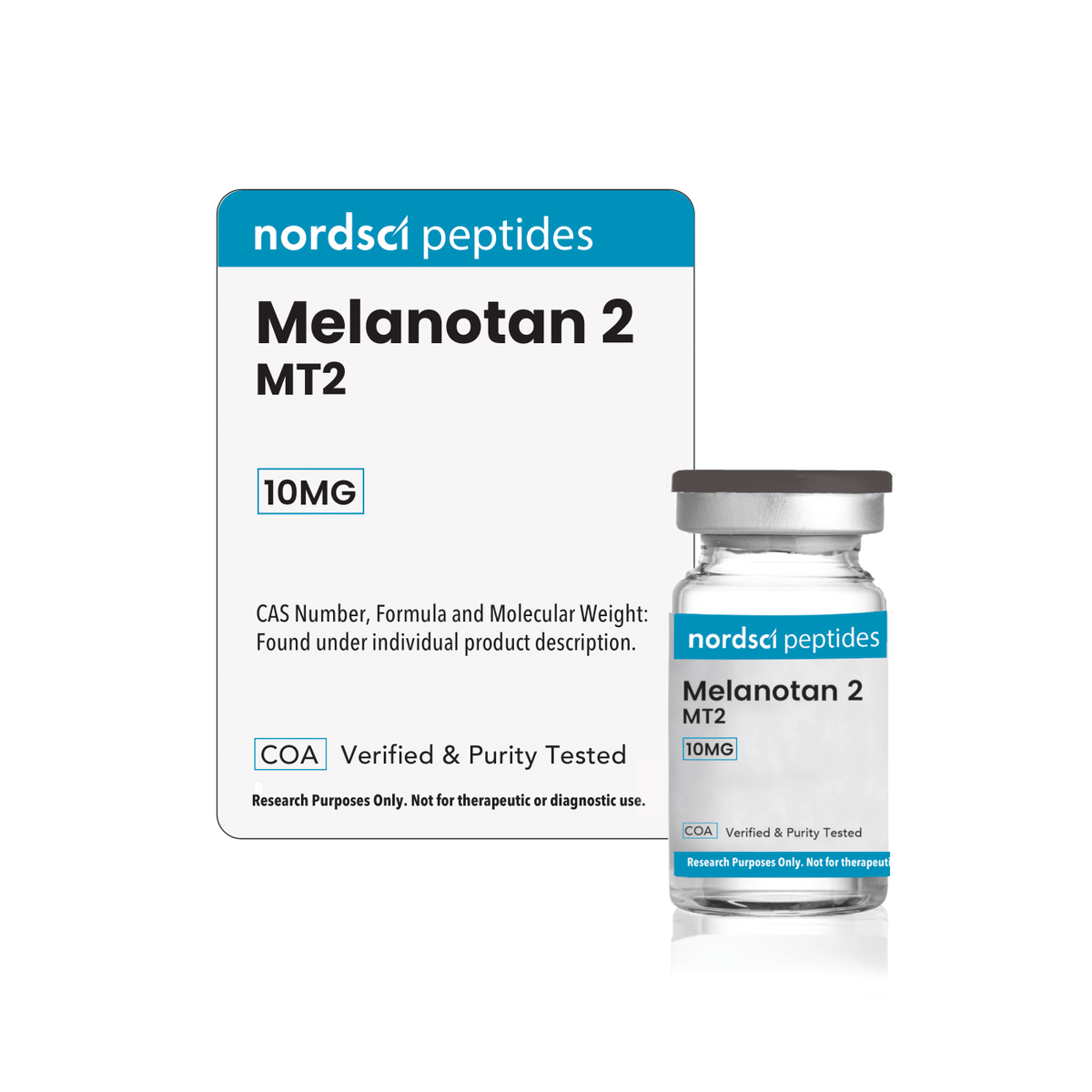
More about Melanotan II (10mg)
Melanotan II, often abbreviated as MT-2, is a high-purity research-grade melanocortin peptide developed for controlled laboratory investigation of pigmentation signaling, melanocyte activation pathways, and melanocortin receptor biology. MT-2 is commonly referenced as an analog derived from the broader alpha-melanocyte-stimulating hormone research lineage and is used in preclinical models evaluating melanogenesis endpoints, receptor-binding behavior, and downstream signaling cascades.
Each vial is produced to research-grade standards and supported by analytical validation to help laboratories maintain reproducibility across cohorts, timepoints, and assay conditions. Teams building broader skin, receptor, and multi-pathway research programs may also review Nordsci resources on hair and dermal vitality research, comparative tissue-signaling frameworks, and multi-pathway protocol design when organizing comparator arms.
Melanotan II Research Peptide Specifications:
| Unit Size | 10mg/vial |
| Unit Quantity | 1 vial |
| Purity (HPLC) | 99.9% |
| Sequence | Ac-Nle-cyclo(-β-Asp-His-D-Phe-Arg-Trp-ε-Lys-NH2) |
| Molecular Formula | C50H69N15O9 |
| Molecular Weight | ≈ 1024.2 g/mol |
| CAS Number | 121062-08-6 |
| Appearance | Lyophilized white powder |
| Source | Chemical synthesis |
| Storage Conditions | Store lyophilized MT-2 at −20 °C or below, protected from light and moisture. Reconstituted solutions should be stored at 2–8 °C and handled according to institutional stability guidance. |
| Research Use Only | This peptide is supplied exclusively for laboratory research use. Not for human consumption, clinical use, or veterinary applications. |
What Is Melanotan II? Research Background and Mechanism
In melanocortin research, MT-2 is primarily discussed in the context of receptor-mediated signaling. Melanocortin receptors regulate a wide spectrum of biological functions in model systems, with MC1R frequently associated with melanocyte activity and pigmentation signaling. In controlled experimental settings, MT-2 is utilized to probe:
- Melanocyte stimulation and melanin synthesis signaling pathways
- Receptor-binding behavior and downstream second-messenger dynamics
- Pigmentation-related endpoints in in vitro and in vivo preclinical models
Because melanocortin signaling can intersect with broader neuroendocrine and behavioral pathways in certain models, MT-2 may also appear in literature adjacent to appetite, arousal, or central signaling discussions. These references remain strictly research-context descriptors and should be treated as mechanistic exploration rather than validated human outcomes.
In practice, the strongest melanocortin study designs tend to keep endpoint categories distinct. Pigmentation quantification, dermal context markers, receptor-binding assays, and broader neuroendocrine observations are typically more interpretable when they are separated into clear arms rather than collapsed into one protocol. For broader context on organizing those systems, Nordsci’s content on age-stratified stack models and stack architecture can support cleaner framework planning.
Important Research Notice: Nordsci peptides are supported by independent third-party analytical testing to validate identity and purity via HPLC and mass spectrometry. A Certificate of Analysis is available for each lot to support documentation, QC reviews, and protocol alignment.
THIS PRODUCT IS INTENDED FOR LABORATORY RESEARCH USE ONLY. NOT FOR HUMAN CONSUMPTION. NOT INTENDED TO DIAGNOSE, TREAT, CURE, OR PREVENT ANY DISEASE OR CONDITION.
Melanotan II Research: Key Laboratory Applications
1. Pigmentation and Melanogenesis Research Models
MT-2 is commonly integrated into study designs focused on melanogenesis and pigmentation signaling. Typical endpoints in these models include melanin quantification, melanocyte activity markers, receptor-level binding assays, and downstream pathway activation readouts that map to melanocortin signaling cascades.
In multi-variable designs, researchers often compare pigmentation-focused signaling against broader dermal vitality or tissue-context markers to understand how isolated melanocortin activity behaves within a more complete skin-related dataset. That kind of structure is especially useful when studies need tighter separation between primary and secondary readouts.
2. Skin-Related Signaling Pathways and Dermal Context Studies
Skin-facing research programs often examine pigmentation as one dimension of a larger dermal signaling environment. Within these frameworks, MT-2 may be used to isolate melanocortin-driven signals, while other study arms help contextualize tissue remodeling, barrier biology, or structural support pathways.
Because those pathways are not interchangeable, high-integrity protocol design usually treats them as separate modules. Teams refining those environments may find additional value in Nordsci’s related educational content on dermal and hair-related research and comparative healing frameworks.
3. Melanocortin Receptor Biology and Binding Assays
For receptor-focused laboratories, MT-2 is a tool for characterizing melanocortin receptor engagement, dose-response curves, and signaling behavior under standardized assay conditions. These experiments are typically designed with tight control over peptide handling, exposure windows, and analytical readouts to minimize assay noise.
4. Comparative Research Within Melanocortin-Related Study Programs
MT-2 is sometimes discussed within broader melanocortin-related research programs where the goal is to distinguish pigmentation-focused hypotheses from central-signaling or behavioral hypotheses where applicable. In these designs, research teams commonly separate endpoint categories early so observed changes can be assigned to the correct mechanism with less interpretive ambiguity.
That approach becomes increasingly important as cohorts expand and comparison arms multiply. In practical terms, verified identity, lot documentation, and disciplined protocol logging become core operational inputs for cleaner receptor biology datasets.
Melanotan II Research Handling, Reconstitution, and Protocol Notes
High-level laboratory guidance: Reconstitution volume, diluent selection, aliquoting strategy, and storage duration should be set by internal SOPs and assay requirements. Many research teams reduce variability by minimizing freeze–thaw cycles through aliquoting and maintaining temperature logs.
Protocol design considerations that typically improve data quality:
- Endpoint clarity: define whether the primary goal is pigmentation quantification, receptor-binding kinetics, or downstream signaling readouts.
- Exposure discipline: control light, temperature, and timing variables that can influence sensitive assays.
- Comparator arms: establish single-agent response curves before evaluating combinations or broader stacks.
- Documentation rigor: attach lot identifiers and COAs to protocol files for reproducibility.
Note: This information is provided as a high-level research reference only. All experimental use must be conducted by qualified personnel in appropriately equipped facilities, following applicable regulations and institutional standards.
Melanotan II Certificate of Analysis (COA) – Lab Testing
Each lot of Melanotan II is supported by a Certificate of Analysis documenting identity and purity, commonly including HPLC and mass spectrometry confirmation as applicable. COAs are available to support internal QC workflows, procurement requirements, and protocol documentation.
Where to Buy Melanotan II (10mg) for Research Purposes
For research programs, supplier selection should be driven by consistent purity standards, transparent documentation, and repeatable lot performance. Nordsci Peptides supports research-grade procurement with third-party testing and clear labeling to help labs execute pigmentation and receptor biology studies with confidence.
IMPORTANT: Melanotan II is sold exclusively for in vitro and preclinical research applications. It is not approved for human use or any therapeutic purpose. Researchers are responsible for compliance with all applicable regulations and institutional policies.
Scientific References
- Foundational literature on melanocortin receptor signaling and α-MSH lineage peptides, including MC1R-associated melanogenesis pathways.
- Preclinical studies evaluating melanocortin receptor agonists in pigmentation and melanocyte activation models, including dose-response and receptor-binding assays.
- Methods literature on peptide handling best practices, including aliquoting, stability awareness, light and temperature controls, and minimizing freeze–thaw variability.
- Comparative research discussions on melanocortin-derived peptides and distinct mechanistic modules, including pigmentation versus broader signaling hypotheses where applicable.
- Analytical chemistry references for HPLC and mass spectrometry identity confirmation in peptide quality-control programs.
Related Research Articles