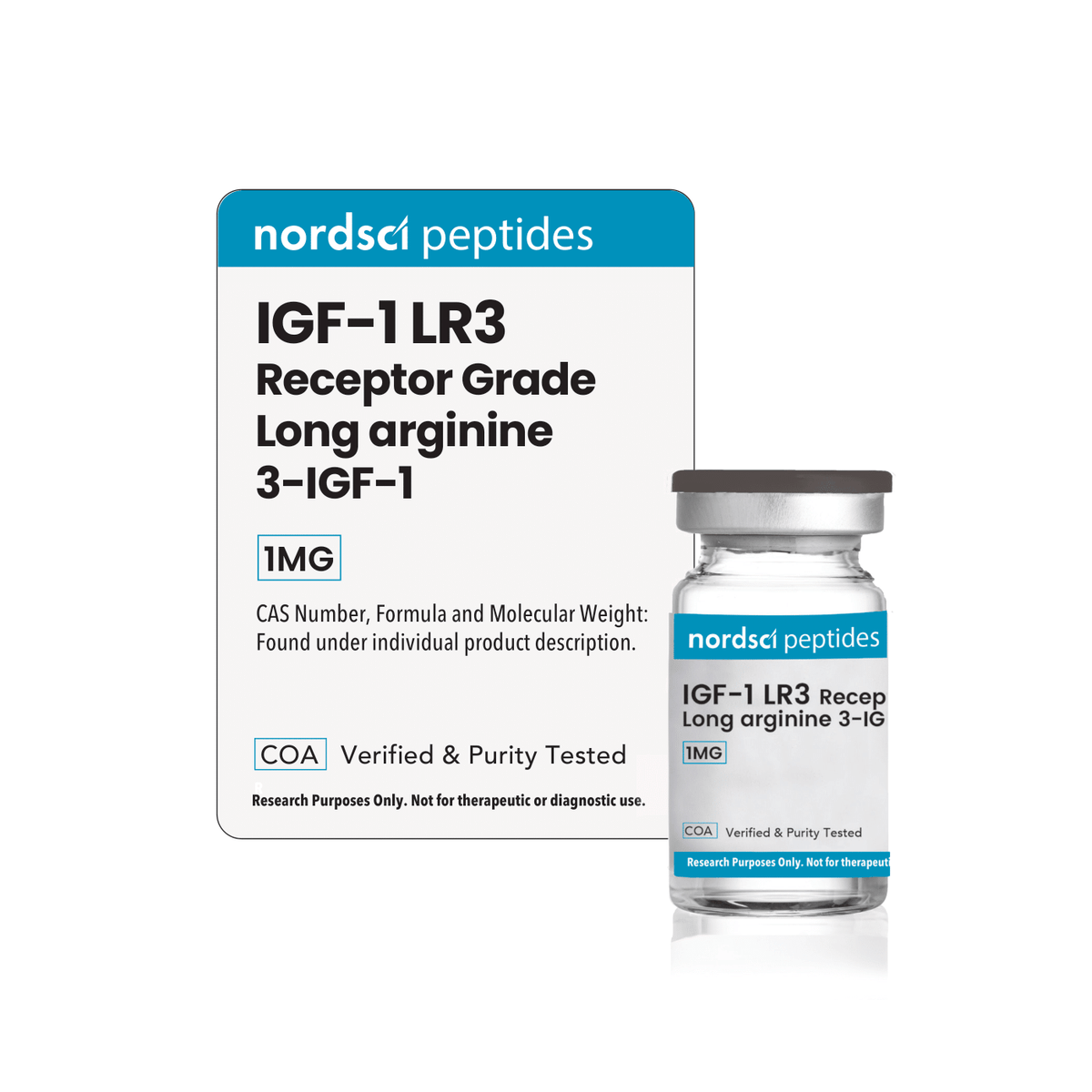
More about IGF-1 LR3 (1mg)
IGF-1 LR3 is a modified insulin-like growth factor research peptide commonly used in controlled laboratory studies investigating IGF receptor signaling, downstream anabolic pathway activation, and tissue-level growth-factor biology. The LR3 format is typically discussed in research contexts for its altered receptor-binding and kinetic profile versus native IGF-1, making it a frequently selected tool compound for protocol-driven IGF pathway exploration.
This product is supplied exclusively for laboratory research applications and is supported by third-party analytical testing documentation to help research teams maintain strong internal quality controls and reproducibility standards. Laboratories building broader growth-factor and endocrine pipelines may also review Nordsci resources on multi-compound peptide stack design, growth-hormone secretagogue research models, and lyophilized peptide handling best practices when standardizing experimental workflows.
IGF-1 LR3 Research Peptide Specifications:
| Unit Size | 1mg/vial |
| Unit Quantity | 1 vial |
| Purity (HPLC) | See lot-specific COA for verified purity and analytical methods |
| Identity Verification | See lot-specific COA for mass spectrometry confirmation and method details |
| Sequence / Molecular Data | See lot-specific COA for sequence confirmation references and molecular characterization |
| Appearance | Lyophilized powder |
| Source | Chemical synthesis |
| Storage Conditions | Store lyophilized IGF-1 LR3 at −20 °C or below, protected from light and moisture. Reconstituted solutions should be stored at 2–8 °C and used in accordance with institutional stability guidance and study requirements. |
| Research Use Only | Supplied exclusively for laboratory research use. Not for human consumption, clinical use, or veterinary applications. |
What Is IGF-1 LR3? Research Background and Mechanism
Insulin-like growth factor signaling is a core pathway in cellular growth, differentiation, and nutrient-partitioning biology. In preclinical and in vitro research, IGF-related compounds are often used to study receptor-mediated signaling cascades such as PI3K/AKT and MAPK pathway activity, changes in protein synthesis markers, and shifts in cell growth behavior under controlled stimulus conditions.
IGF-1 LR3 is frequently positioned as a practical laboratory tool because it is referenced in the literature as having an altered interaction profile compared with native IGF-1. In experimental design, researchers may use IGF-1 LR3 to create a consistent, measurable IGF-axis stimulus for pathway mapping, comparative receptor response testing, and tissue-specific signaling studies.
In larger program design, IGF-axis studies are often most valuable when separated clearly from upstream endocrine stimulation models and tissue-repair models. That is why research teams commonly structure comparator arms and timeline-based sampling strategies before scaling cohort size. For broader planning context, Nordsci’s educational content on stack architecture and storage and handling workflows can help tighten those systems.
Important Research Notice: Nordsci peptides are supported by independent third-party analytical testing to validate identity and purity via methods such as HPLC and mass spectrometry. A Certificate of Analysis is available for each lot to support protocol files, quality control workflows, and documentation requirements.
THIS PRODUCT IS INTENDED FOR LABORATORY RESEARCH USE ONLY. NOT FOR HUMAN CONSUMPTION. NOT INTENDED TO DIAGNOSE, TREAT, CURE, OR PREVENT ANY DISEASE OR CONDITION.
IGF-1 LR3 Research: Key Laboratory Applications
1. IGF Receptor Signaling and Downstream Pathway Mapping
IGF-1 LR3 is commonly used in mechanistic research to evaluate IGF receptor activation and downstream signaling behavior. Studies frequently track pathway-level readouts such as phosphorylation markers, gene expression changes, and time-dependent signaling kinetics across cell lines or tissue samples.
In programs where growth-factor signaling is evaluated alongside broader endocrine frameworks, laboratories often benchmark IGF-axis tools against upstream stimulation models in separate arms to preserve interpretability. Researchers organizing those comparisons may also find value in Nordsci’s content on growth-hormone axis model design.
2. Protein Synthesis Markers and Cellular Growth-Response Models
In controlled models, investigators may include IGF-1 LR3 when studying cellular growth-response behavior under standardized nutrient conditions. Research endpoints can include protein synthesis markers, cellular hypertrophy signals, and comparative response curves between different stimulus intensities or exposure windows.
These models are typically designed with strict controls to separate signaling effects from confounders such as serum variability, baseline metabolic stress, or cell-cycle differences. That level of design discipline becomes especially important when studies are scaled across multiple cohorts or repeated over time.
3. Tissue-Level Growth-Factor Biology and Recovery-Adjacent Research Endpoints
In animal and tissue models, IGF-axis signaling is often evaluated in the context of remodeling and recovery-adjacent biology. IGF-1 LR3 may be used as a signaling probe in studies tracking tissue adaptation markers, growth-factor-related transcription patterns, and structural pathway activity in response to controlled stressors or interventions.
Where tissue integrity and signaling behavior are also under review, laboratories often create separate study arms so growth-factor endpoints remain distinct from repair-oriented endpoints. This approach improves interpretability and reduces noise across datasets.
4. Comparative Signaling Studies Within Multi-Compound Research Programs
IGF-1 LR3 is frequently integrated into larger research programs as a comparator compound to help distinguish upstream endocrine stimulation from downstream IGF-axis signaling. In these designs, the goal is typically clarity: determining whether observed effects are best explained by hormone-release dynamics, receptor-level IGF stimulation, or downstream transcriptional shifts.
For teams running multi-phase programs, clean sourcing, lot traceability, and documentation standards are not minor details. They are core operational inputs that support repeatable signaling data across phases and cohorts.
IGF-1 LR3 Certificate of Analysis (COA) – Lab Testing
Each lot of IGF-1 LR3 is supported by a Certificate of Analysis documenting identity and analytical characterization. COA documentation can be used for protocol files, internal QC review, or procurement documentation where research teams require traceable inputs for multi-phase study execution.
Where to Buy IGF-1 LR3 for Research Purposes
Sourcing IGF-1 LR3 for institutional use requires a supplier with robust documentation, consistent labeling, and repeatable quality controls. Nordsci Peptides focuses on research-grade peptides supported by third-party testing and lot traceability, enabling laboratories to execute protocol-driven research with reliable inputs.
IMPORTANT: IGF-1 LR3 is sold exclusively for in vitro and preclinical research applications. It is not approved for human use or any therapeutic purpose. Researchers are responsible for complying with all applicable regulations and institutional policies governing peptide research in their jurisdiction.
Scientific References
- Peer-reviewed literature on insulin-like growth factor receptor biology and downstream signaling pathways including PI3K/AKT and MAPK used in preclinical and in vitro research.
- Research literature comparing native IGF-1 signaling behavior to modified IGF analogs used in laboratory models, including kinetic and receptor-interaction discussions.
- Preclinical studies evaluating growth-factor signaling readouts, protein synthesis markers, and tissue-level adaptation endpoints under controlled experimental conditions.
- Methodology references on peptide handling, stability-aware storage, aliquoting practices, and analytical verification via HPLC and mass spectrometry.
- Laboratory best practices for documentation, including COA archiving, lot traceability, and SOP-driven procurement workflows for reproducible research.
Related Research Articles