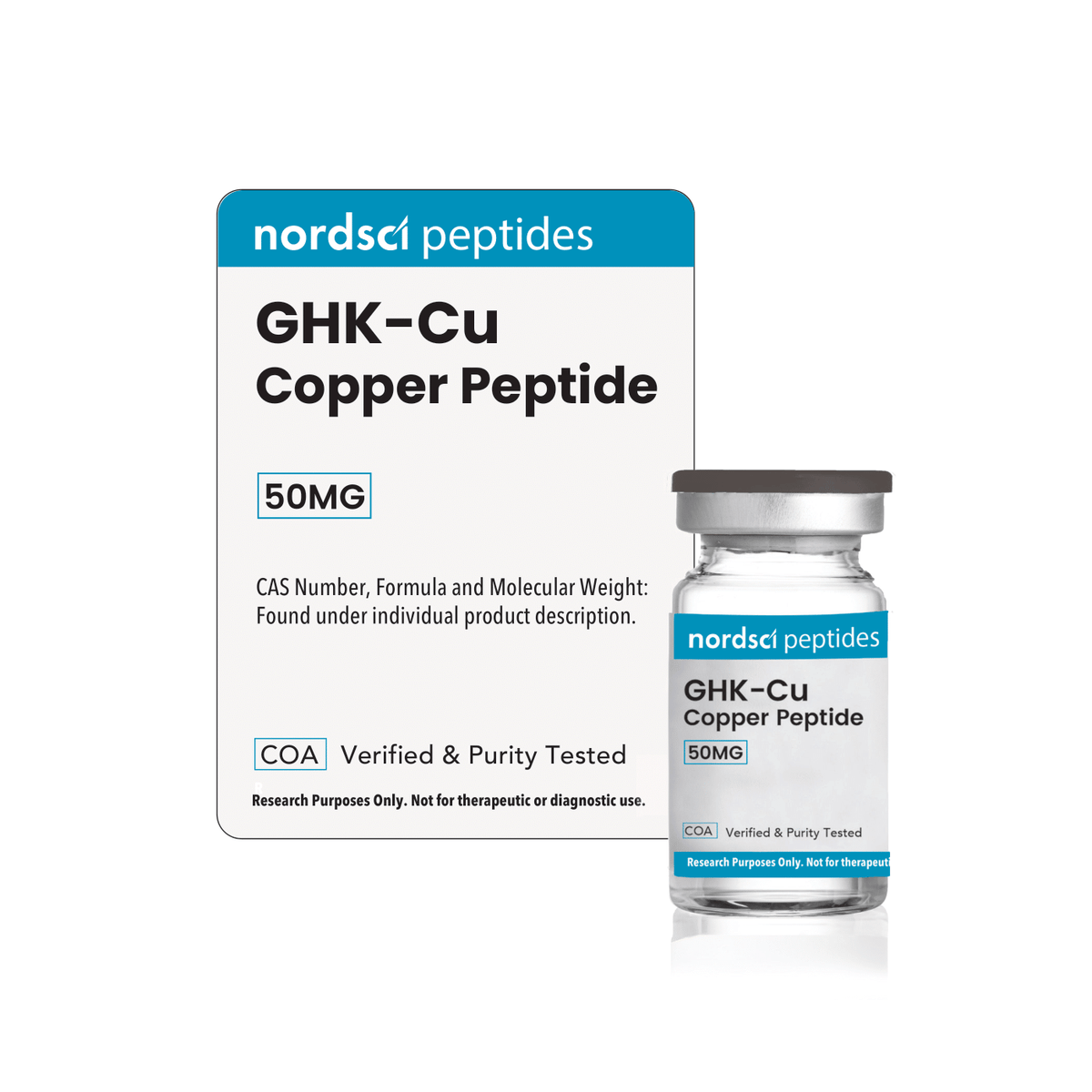
More about GHK-Cu
GHK-Cu is a high-purity copper-binding tripeptide complexed with copper(II), supplied for controlled laboratory research on tissue remodeling, collagen dynamics, and regenerative signaling. This research-grade peptide is synthesized to stringent specifications and validated by third-party analytical testing to support reproducible preclinical work.
Because of its broad mechanistic footprint, GHK-Cu is frequently used in research programs focused on extracellular matrix regulation, oxidative stress, and repair-associated signaling. Teams building broader study pipelines often also review Nordsci resources on collagen regeneration evidence, copper peptide research applications, and how peptide stacks are structured in preclinical design when mapping related endpoints.
GHK-Cu Research Peptide Specifications:
| Unit Size | 100 mg/vial |
| Unit Quantity | 1 vial |
| Purity (HPLC) | > 99% |
| Sequence | Gly–His–Lys–Cu²⁺ (GHK-Cu complex) |
| Molecular Formula | C14H22CuN6O4 (GHK-Cu complex) |
| Molecular Weight | ~404.9 g/mol |
| Appearance | Lyophilized blue-green powder |
| Source | Chemical synthesis |
| Storage Conditions | Store lyophilized GHK-Cu at -20°C in a dry, dark environment. After reconstitution, store at 4°C and use within the recommended research holding period according to institutional guidelines. |
| Research Use Only | This research peptide is intended for laboratory research use only. Not for human consumption, clinical use, or therapeutic applications. |
What is GHK-Cu? Research Background and Mechanism
GHK-Cu, or glycyl-L-histidyl-L-lysine–copper, is a naturally occurring tripeptide–metal complex identified in human plasma, saliva, and urine. Endogenous levels of GHK-Cu decline with age, making it a compelling candidate for research on age-associated changes in tissue repair capacity and extracellular matrix remodeling.[1,2]
In laboratory models, GHK-Cu has been shown to modulate gene expression programs associated with collagen synthesis, matrix turnover, antioxidant defenses, and inflammatory signaling. Research indicates that GHK-Cu can influence both synthesis and controlled breakdown of collagen and glycosaminoglycans, as well as the activity of matrix metalloproteinases and their inhibitors.[1,3]
Preclinical data suggest that GHK-Cu supports:
- Collagen and elastin synthesis in dermal fibroblasts
- Angiogenesis and microvascular remodeling in wound environments
- Regulation of oxidative stress and inflammatory mediators
- Tissue remodeling in skin, connective tissue, and other organ systems
Because of this broad mechanistic footprint, GHK-Cu is frequently used as a model peptide for regenerative research, anti-aging studies, and investigations into skin barrier repair and post-injury remodeling pathways. Researchers comparing adjacent study architectures may also find value in Nordsci’s material on anti-aging and recovery comparison frameworks and multi-compound stack design.
GHK-Cu Research Focus Areas
1. Skin Remodeling, Collagen Dynamics, and Anti-Aging Pathways
GHK-Cu has been extensively studied for its impact on dermal remodeling. In vitro and in vivo models demonstrate that GHK-Cu can promote collagen and glycosaminoglycan production, enhance dermal density, and support more organized extracellular matrix architecture.[1,3] These mechanistic findings align with research evaluating GHK-Cu in the context of wrinkle reduction, photoaging models, and overall skin firmness and elasticity.
Laboratory investigations have also explored how GHK-Cu may modulate metalloproteinase activity, supporting a more favorable balance between collagen synthesis and controlled matrix degradation. This dual impact makes GHK-Cu a useful research tool for examining healthy matrix turnover rather than simple overproduction of structural proteins.
2. Wound Healing, Angiogenesis, and Tissue Repair
GHK-Cu has demonstrated pro-regenerative effects in a variety of wound-healing models, including cutaneous wounds and ischemic tissue environments.[1,2,4] Research suggests that GHK-Cu can accelerate wound contraction, enhance granulation tissue formation, and support angiogenesis through modulation of growth factors and endothelial cell behavior.
These findings position GHK-Cu as a valuable tool compound for exploring re-epithelialization, fibroblast recruitment, extracellular matrix organization, and vascular remodeling within damaged tissues. For teams expanding repair-focused study design, related Nordsci reading on regenerative research applications and collagen-centered evidence may support cleaner protocol development.
3. Oxidative Stress, Inflammation, and Gene Expression
Preclinical studies indicate that GHK-Cu can exert antioxidant and anti-inflammatory effects, including modulation of reactive oxygen species and inflammatory cytokines in multiple tissue types.[1,2,5] In gene-expression profiling, GHK-Cu has been associated with upregulation of repair-associated pathways and downregulation of several stress- and inflammation-related genes.
GHK-Cu is therefore frequently utilized in in vitro and in vivo models assessing redox signaling, antioxidant defense pathways, chronic wound systems, and age-related declines in regenerative gene programs. This makes it especially relevant in screening environments where signal directionality and pathway mapping matter more than single-endpoint interpretation.
4. Hair Follicle Biology and Scalp Research
Because GHK-Cu participates in dermal remodeling and microvascular support, emerging research has begun to investigate its role in hair follicle biology and scalp tissue environments. These preclinical investigations focus on follicular miniaturization, dermal papilla cell activity, and local perfusion, utilizing GHK-Cu as a probe for pathways that interface between skin health and hair growth.
Important Research Notice: Nordsci peptides undergo independent third-party laboratory testing to verify purity and identity. Certificate of Analysis documentation is available for each research lot to support rigorous scientific methods and quality assurance.
THIS PRODUCT IS INTENDED FOR LABORATORY RESEARCH USE ONLY. NOT FOR HUMAN CONSUMPTION. NOT INTENDED TO DIAGNOSE, TREAT, CURE, OR PREVENT ANY DISEASE OR CONDITION.
GHK-Cu Certificate of Analysis (COA) – Lab Testing
Nordsci provides batch-specific analytical documentation for GHK-Cu, including HPLC chromatograms and mass spectrometry identity confirmation.
Download GHK-Cu COA Lab Test Results
Where to Buy GHK-Cu for Research Purposes
Research-grade GHK-Cu should be sourced from suppliers capable of delivering high-purity peptide, validated identity, and transparent quality documentation. Nordsci specializes in research-only peptides and stacks that support rigorous preclinical design, with a focus on consistency across lots and clearly defined specifications.
How to Source GHK-Cu for Laboratory Research
When evaluating suppliers, researchers should confirm that each lot of GHK-Cu is accompanied by clear analytical documentation, documented sequence and molecular characteristics, storage guidance, and a defined research-use-only designation. Strong documentation protects dataset integrity and simplifies internal review.
GHK-Cu Research Peptide Pricing Considerations
Pricing for GHK-Cu varies by purity grade, quantity, and formulation strategy. Laboratories should budget not only for the peptide itself but also for appropriate storage, handling, and analytical verification where required by institutional policies.
Research Institution Procurement and Compliance
Procurement teams and principal investigators should ensure that GHK-Cu acquisition aligns with internal purchasing policies, chemical inventory management systems, and safety documentation requirements. Proper labeling, secure storage, and access control are key to maintaining compliance across ongoing research programs.
IMPORTANT: GHK-Cu is sold exclusively for in vitro research and laboratory applications. It is not approved for human use, clinical protocols, or any therapeutic application. Researchers are responsible for adhering to all applicable regulations governing peptide research in their jurisdiction.
Scientific References
- Pickart L, Vasquez-Soltero JM, Margolina A. Regenerative and protective actions of the GHK-Cu peptide in the light of the new gene data. Int J Mol Sci. 2018.
- Dou Y, Luo X, Li X, et al. The potential of GHK as an anti-aging peptide. Clin Cosmet Investig Dermatol. 2020.
- Pickart L, Margolina A. The human tripeptide GHK-Cu in prevention of oxidative stress and inflammation. Oxid Med Cell Longev. 2012.
- Adnan SB, et al. Exploring the role of tripeptides in wound healing and tissue regeneration. Int J Med Sci. 2025.
- Copper peptide GHK-Cu – molecular characteristics and biological overview.
ALL ARTICLES AND PRODUCT INFORMATION PROVIDED ON THIS WEBSITE ARE FOR INFORMATIONAL AND EDUCATIONAL PURPOSES ONLY.
The products offered on this website are furnished for in-vitro studies only. In-vitro studies are performed outside of the body. These products are not medicines or drugs and have not been approved by the FDA to prevent, treat, or cure any medical condition, ailment, or disease. Bodily introduction of any kind into humans or animals is strictly forbidden by law.
Related Research Articles